Español
 العربية
 Pусский

The two stage double acting reciprocating compressor is a powerhouse in the world of industrial air compression, blending efficiency with the ability to handle higher pressures. This advanced compressor design is a go-to solution for industries requiring robust, reliable performance, from oil and gas to refrigeration. In this article, we’ll explore what makes the two stage double acting reciprocating compressor unique, how it operates, its advantages, and why partnering with a supplier like Kito—a senior air compressor manufacturer from China—can elevate its value. Whether you’re optimizing a production line or researching compressor technology, this guide offers everything you need to know.
Introduction to Two Stage Double Acting Reciprocating Compressors
Definition and Core Concept
A two stage double acting reciprocating compressor is a positive displacement compressor that compresses air or gas in two distinct stages while utilizing both sides of the piston for compression in each stage. Unlike single-acting compressors that compress only on one stroke, the double-acting design doubles the compression cycles per revolution. The two-stage process further enhances this by compressing the air twice—first at a lower pressure, then at a higher pressure after cooling—making it ideal for applications needing elevated pressure levels.
The essence of this design lies in its ability to maximize output and efficiency. By combining dual-action pistons with staged compression, the two stage double acting reciprocating compressor delivers more compressed air per cycle than simpler models, achieving pressures up to 175–250 PSI or higher in specialized setups.
Evolution and Modern Relevance
Reciprocating compressors date back to the Industrial Revolution, evolving from basic single-acting designs to sophisticated multi-stage systems like the two stage double acting reciprocating compressor. Once a staple in mining and manufacturing, these compressors have seen their dominance challenged by rotary screw technology in recent decades due to size and noise concerns. However, they retain a niche relevance in applications requiring constant flow and moderate-to-high pressures, bolstered by modern suppliers like Kito who refine them with cutting-edge manufacturing.
Working Principle and Design
Operational Mechanism
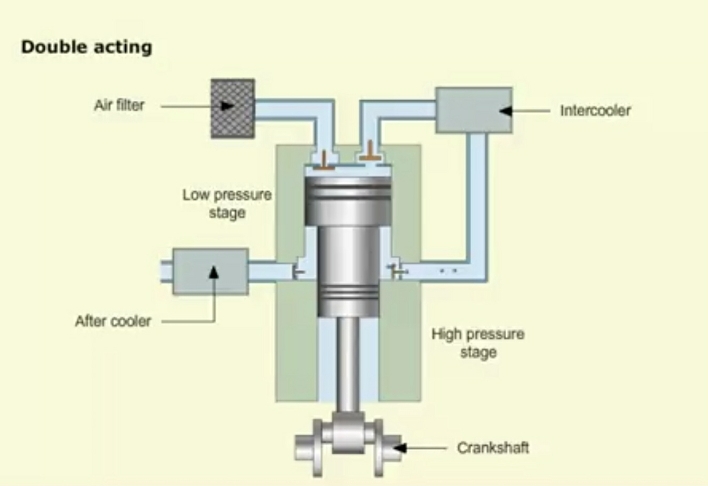
The two stage double acting reciprocating compressor operates through a meticulously coordinated process. In the first stage, the piston draws air into the cylinder on one stroke, compressing it on both the forward and backward movements thanks to the double-acting design. This compressed air, now at an intermediate pressure, passes through an intercooler to reduce its temperature—a critical step to prevent overheating and improve efficiency. The cooled air then enters the second stage, where another double-acting piston compresses it further to the desired high pressure, typically 175–250 PSI, before discharge.
This two-stage, dual-action mechanism ensures the two stage double acting reciprocating compressor delivers a steady, high-pressure output with reduced energy waste, making it a standout choice for demanding industrial tasks.
Key Components
The two stage double acting reciprocating compressor relies on a robust set of components:
Pistons: Two per stage, compressing air on both strokes.
Cylinders: House the pistons, one for each stage.
Crankshaft: Drives piston movement via connecting rods.
Crosshead: Ensures precise, linear piston motion.
Intercooler: Cools air between stages for efficiency.
Valves: Inlet and discharge valves manage airflow.
These parts, engineered for durability, enable the compressor to handle high-pressure loads. Suppliers like Kito enhance these components with precision manufacturing, ensuring longevity and performance.
Advantages of Two Stage Double Acting Reciprocating Compressors
Enhanced Efficiency
The two stage double acting reciprocating compressor excels in energy efficiency, boasting an operating range of 15–16 kW/100 cfm compared to 22–24 kW/100 cfm for single-acting models. By compressing air on both piston strokes and cooling it between stages, it reduces energy loss, lowering operational costs—a key benefit for industries aiming to optimize power usage.
Higher Pressure Capacity
Unlike single-stage compressors limited to ~125 PSI, the two stage double acting reciprocating compressor achieves pressures up to 250 PSI or more in advanced designs. The two-stage process splits the compression load, allowing it to tackle high-pressure applications like gas pipeline boosting or heavy-duty manufacturing with ease.
Durability and Reduced Stress
The double-acting design reduces cyclic load peaks, easing mechanical stress on components like the crankshaft and connecting rods. Combined with sturdy construction, the two stage double acting reciprocating compressor offers exceptional durability, minimizing wear and extending service life even in harsh conditions.
Advantages of Kito as a Senior Supplier from China
Choosing a two stage double acting reciprocating compressor from Kito, a senior Chinese supplier, amplifies its benefits:
Precision Engineering: Kito’s adherence to global standards (e.g., ISO9001) ensures each compressor is built for optimal performance and reliability.
Cost Efficiency: Leveraging China’s manufacturing scale, Kito offers competitive pricing, making high-quality compressors accessible to budget-conscious buyers.
Reliable Support: With decades of expertise, Kito provides dependable logistics and after-sales service, reducing downtime for industrial clients.
Tailored Solutions: Kito customizes compressors to meet specific pressure or capacity needs, enhancing their versatility.
Kito’s strengths make their two stage double acting reciprocating compressor a compelling choice for industries seeking value and performance.
Applications and Use Cases
Industrial Applications
The two stage double acting reciprocating compressor shines in industries requiring high-pressure, constant-flow air or gas. In oil and gas, it boosts pipeline pressures; in refrigeration, it compresses refrigerants efficiently; and in manufacturing, it powers pneumatic tools for heavy-duty tasks. Its ability to deliver reliable output makes it indispensable for these sectors.
Limitations in Modern Context
Despite its strengths, the two stage double acting reciprocating compressor faces challenges. Its large size (rarely under 100 HP), noise, and vibration limit its use in compact or noise-sensitive settings. For ultra-high pressures beyond 250 PSI, multistage or rotary screw compressors may be preferred, positioning this design as niche-specific rather than universally applicable.
Comparison with Other Compressor Types
Single Stage vs. Two Stage Double Acting
A single-stage double-acting compressor compresses air in one step, capping out at ~125 PSI, while the two stage double acting reciprocating compressor doubles the process for higher pressures (175–250 PSI) and better efficiency. The two-stage model outperforms in capacity and energy use, ideal for more demanding tasks.
Double Acting vs. Single Acting
Single-acting compressors compress air on one stroke, limiting capacity and efficiency (22–24 kW/100 cfm). The two stage double acting reciprocating compressor, with compression on both strokes across two stages, doubles throughput and achieves 15–16 kW/100 cfm, offering a clear advantage in productivity.
Maintenance and Operational Considerations
Maintenance Needs
The two stage double acting reciprocating compressor requires regular maintenance—checking valves, pistons, and the intercooler—to ensure peak performance. With fewer moving parts than multistage systems, upkeep is manageable, though its vibration demands a solid foundation and isolation measures to protect longevity.
Operational Challenges
Noise and vibration are inherent challenges, requiring strategic placement and soundproofing. Performance can also dip due to clogging or high ambient temperatures, as studies show a 26% volumetric efficiency loss from such factors. Proper environmental controls are essential to maintain the two stage double acting reciprocating compressor’s effectiveness.
Why Choose Kito for Two Stage Double Acting Compressors?
Kito’s Expertise and Innovation
Kito’s decades-long experience as a senior supplier ensures their two stage double acting reciprocating compressor is optimized for efficiency and durability. Their innovative approach—refining designs with advanced materials and cooling systems—delivers reliable performance tailored to modern industrial needs.
Strategic and Economic Benefits
Kito offers affordable, high-quality compressors backed by a global supply chain, minimizing costs and delays. For industries needing a robust two stage double acting reciprocating compressor, Kito’s blend of economic value and technical excellence maximizes return on investment.
Conclusion
Summary of Benefits
The two stage double acting reciprocating compressor combines enhanced efficiency, high pressure capacity, and durability, making it a top choice for specific industrial applications. With Kito’s precision engineering, cost efficiency, and reliable support, it becomes an even more attractive solution for businesses prioritizing performance and value.
Future Prospects
Though rotary screw compressors dominate many markets, the two stage double acting reciprocating compressor retains relevance for high-pressure, constant-flow needs. Supported by suppliers like Kito, who adapt it with modern enhancements, this technology continues to serve niche industrial roles effectively.