Español
 العربية
 Pусский
When it comes to industrial air compression, the single stage double acting reciprocating compressor stands out as a reliable and efficient solution. Known for its robust design and ability to maximize output, this compressor type has been a staple in industries worldwide, from manufacturing to oil and gas. In this article, we’ll dive deep into what makes the single stage double acting reciprocating compressor unique, how it works, its advantages, and why choosing a supplier like Kito—a senior air compressor manufacturer from China—can elevate your operations. Whether you’re an engineer, a business owner, or simply curious about compressor technology, this guide has you covered.
Introduction to Single Stage Double Acting Reciprocating Compressors
Definition and Basic Concept
A single stage double acting reciprocating compressor is a type of positive displacement compressor that uses a single cylinder to compress air or gas on both the forward and backward strokes of the piston. Unlike single-acting compressors, which compress air only on one stroke, the double-acting design doubles the compression cycles per piston movement. This results in a higher flow rate and greater efficiency, making it a preferred choice for applications requiring steady, moderate-pressure air supply.
The essence of this technology lies in its ability to optimize output per cycle. By compressing air on both sides of the piston, it delivers more compressed air with less energy compared to its single-acting counterparts, offering an efficiency of around 15–16 kW per 100 cubic feet per minute (cfm), as opposed to 22–24 kW/100 cfm for single-acting models.
Historical Context and Evolution
The reciprocating compressor is one of the oldest forms of air compression technology, tracing its roots back to the Industrial Revolution. Over time, the single stage double acting reciprocating compressor evolved to meet growing industrial demands for efficiency and reliability. Companies like Quincy and Gardner Denver have refined this design, though modern alternatives like rotary screw compressors have gained ground. Still, the double-acting reciprocating compressor remains relevant, thanks to its proven performance and adaptability, enhanced by suppliers like Kito who bring advanced manufacturing to the table.
Working Principle and Mechanism
How It Operates
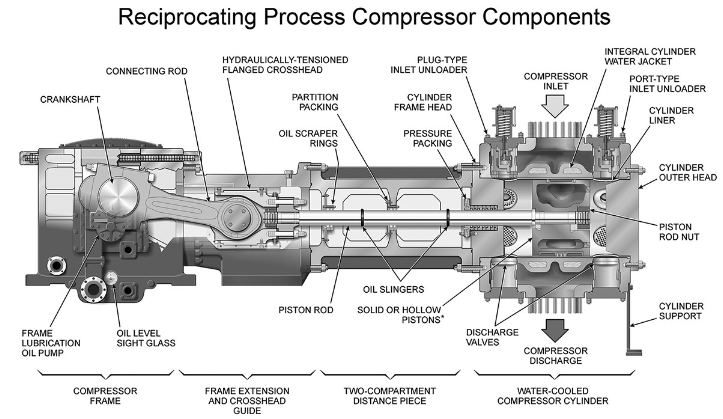
At the heart of the single stage double acting reciprocating compressor is a piston driven by a crankshaft, connected via a rod and crosshead. As the piston moves forward, it compresses air on one side of the cylinder while simultaneously drawing in air on the opposite side through inlet valves. When it reverses, the process repeats on the other side, with compressed air exiting through discharge valves. This dual-action mechanism ensures continuous compression, boosting productivity and making it ideal for sustained operations.
The seamless integration of mechanical components allows this compressor to deliver reliable performance, even under demanding conditions. Cooling systems, often air or water-based, manage the heat generated during compression, ensuring longevity.
Key Components
The single stage double acting reciprocating compressor comprises several critical parts:
Piston: Compresses air on both strokes.
Cylinder: Houses the piston and facilitates compression.
Crankshaft: Converts rotational energy into piston movement.
Crosshead: Ensures linear piston motion, reducing wear.
Inlet and Discharge Valves: Control air intake and output.
These components work in harmony, with the crosshead playing a pivotal role in maintaining the precision required for double-acting efficiency. High-quality manufacturing, such as that offered by Kito, ensures these parts withstand industrial rigors.
Advantages of Single Stage Double Acting Reciprocating Compressors
High Efficiency
One of the standout benefits of the single stage double acting reciprocating compressor is its energy efficiency. By compressing air on both strokes, it achieves a higher output per cycle, reducing electricity costs. Industry data highlights its efficiency at 15–16 kW/100 cfm, a significant improvement over the 22–24 kW/100 cfm of single-acting compressors. This makes it an economical choice for businesses aiming to optimize energy use without sacrificing performance.
Durability and Longevity
Built with robust materials like cast iron or steel, the single stage double acting reciprocating compressor is designed to endure harsh industrial environments. Its sturdy construction minimizes wear and tear, reducing maintenance frequency and downtime. For industries relying on continuous operation, this durability translates into lower replacement costs and a longer operational lifespan.
Versatility in Applications
From powering pneumatic tools in manufacturing plants to maintaining pipeline pressure in oil and gas operations, the single stage double acting reciprocating compressor excels in diverse applications. Its ability to deliver consistent air at moderate pressures (typically 125–250 PSI) makes it a versatile workhorse across multiple sectors, including air separation and chemical processing.
Advantages of Kito as a Senior Supplier from China
When choosing a single stage double acting reciprocating compressor, the supplier matters as much as the technology. Kito, a senior air compressor manufacturer from China, brings distinct advantages to the table:
High-Quality Manufacturing: Leveraging China’s advanced industrial capabilities, Kito produces compressors that meet international standards like ISO9001. Their precision engineering ensures reliable, high-performance machines.
Cost-Effectiveness: Kito offers competitive pricing thanks to economies of scale and efficient production processes, delivering exceptional value without compromising quality.
Reliable Supply Chain: With decades of experience, Kito guarantees timely delivery and robust after-sales support, minimizing operational disruptions for clients worldwide.
Customization: Kito’s expertise allows them to tailor compressors to specific industrial needs, a flexibility that sets them apart in the market.
These strengths make Kito a top choice for businesses seeking a dependable single stage double acting reciprocating compressor that balances performance and affordability.
Applications and Use Cases
Industrial Applications
The single stage double acting reciprocating compressor shines in industries requiring a steady supply of compressed air or gas. In oil and gas, it maintains pipeline pressures, while in manufacturing, it powers tools and machinery. It’s also widely used in air separation plants, where consistent output is critical. Its ability to handle moderate-pressure tasks makes it indispensable for these high-demand environments.
Limitations in High-Pressure Scenarios
While versatile, the single stage double acting reciprocating compressor is not suited for ultra-high-pressure applications. For pressures exceeding 250 PSI, multistage compressors are preferred due to their ability to compress air in stages. This limitation positions the single stage model as ideal for specific, rather than universal, pressure needs.
Comparison with Other Compressor Types
Single Acting vs. Double Acting
Compared to single-acting compressors, the single stage double acting reciprocating compressor offers superior efficiency and capacity. Single-acting models compress air on one stroke, making them better for intermittent use, while double-acting compressors excel in continuous operation, delivering higher flow rates with less energy.
Single Stage vs. Multistage
The choice between single stage and multistage compressors hinges on pressure requirements. The single stage double acting reciprocating compressor is simpler and more cost-effective for moderate pressures, while multistage models handle higher pressures at the expense of increased complexity and cost. For businesses prioritizing simplicity and efficiency, the single stage option often wins.
Maintenance and Operational Considerations
Maintenance Requirements
The single stage double acting reciprocating compressor boasts fewer moving parts than multistage systems, reducing maintenance needs. Regular checks on valves, pistons, and cooling systems keep it running smoothly. However, its vibration and noise levels require solid foundations and isolation measures to ensure operator comfort and equipment stability.
Operational Challenges
High vibration and noise are notable drawbacks of the single stage double acting reciprocating compressor. These factors can limit its placement in noise-sensitive areas, and it’s less ideal for continuous ultra-high-pressure tasks. With proper installation and maintenance, however, these challenges are manageable, preserving its overall value.
Why Choose Kito for Single Stage Double Acting Compressors?
Kito’s Industry Expertise
As a senior supplier, Kito brings decades of experience to the production of single stage double acting reciprocating compressors. Their deep understanding of compressor technology ensures machines are optimized for durability, efficiency, and performance, earning them a trusted reputation in the global market.
Economic and Strategic Benefits
Kito’s competitive pricing, advanced manufacturing, and global logistics support make them a strategic partner for cost-conscious businesses. By choosing Kito, you gain access to a single stage double acting reciprocating compressor that maximizes return on investment through affordability, reliability, and tailored solutions.
Conclusion
Summary of Benefits
The single stage double acting reciprocating compressor combines efficiency, durability, and versatility, making it a powerhouse for moderate-pressure industrial applications. With suppliers like Kito enhancing its value through high-quality production and cost-effective pricing, it’s a smart choice for businesses aiming to optimize operations.
Future Outlook
While rotary screw compressors have gained popularity, the single stage double acting reciprocating compressor remains a vital technology for specific use cases. Supported by innovative manufacturers like Kito, its relevance endures, offering modern enhancements to a time-tested design.