Español
 العربية
 Pусский
In modern industries, compressed air has become an essential utility, often referred to as the fourth utility alongside water, electricity, and gas. Screw air compressors are pivotal in generating this compressed air, offering unparalleled efficiency, reliability, and consistent performance. Among the various types of screw compressors available, oil-injected screw air compressors and oil-free screw air compressors are two primary categories. Each is designed to meet specific industrial requirements, and understanding their differences is crucial for making the right investment.
Oil-injected screw air compressors rely on lubrication to maintain efficiency and reduce wear, making them suitable for heavy-duty applications where absolute air purity is not a priority. In contrast, oil-free screw air compressors are engineered to deliver 100% oil-free air, meeting stringent standards in industries like food processing, pharmaceuticals, and electronics, where even trace amounts of oil can be problematic.
Selecting between these two types of compressors is not a simple choice. It involves considering factors like operational needs, air purity requirements, maintenance costs, and environmental impact. This comprehensive guide aims to provide an in-depth comparison of oil-injected and oil-free screw air compressors, helping you make an informed decision tailored to your specific needs.
Additionally, we’ll introduce KITO, a leading Chinese supplier of high-quality screw air compressors. Known for their innovation, reliability, and cost-effectiveness, KITO offers solutions for diverse industrial applications, ensuring you achieve optimal performance and value. Whether you prioritize robust performance or impeccable air quality, KITO has a product to suit your needs.
By the end of this article, you’ll have a clear understanding of:
The working principles of both oil-injected and oil-free screw air compressors.
Their advantages, limitations, and ideal use cases.
How to evaluate which type aligns best with your industry requirements.
Let’s dive deeper into this essential industrial equipment and empower you to choose the compressor that will elevate your operations to the next level.
Their advantages, limitations, and ideal use cases.
How to evaluate which type aligns best with your industry requirements.
Let’s dive deeper into this essential industrial equipment and empower you to choose the compressor that will elevate your operations to the next level.
What is Oil Injected Screw Air Compressors?
Oil-injected screw air compressors are the most common type used in industries where the air quality is not strictly regulated. In these systems, a small amount of oil is injected into the air compression chamber to serve as both a lubricant and a coolant. The oil plays a critical role in reducing friction between the moving rotors and helps to dissipate heat generated during compression.
Key Features of Oil Injected Compressors:
Lubrication and Cooling: Oil is injected into the compression chamber, where it lubricates the screws and cools the compressed air.
Air Purity: Though oil is used, the air produced is not completely oil-free. However, the oil is separated from the compressed air by oil separators, which ensure that only minimal oil is present in the output air.
Cost-Effective: Due to the oil lubrication system, these compressors typically have lower initial purchase costs and can be more cost-efficient in terms of long-term maintenance.
Applications: Oil-injected compressors are ideal for industries that do not require completely oil-free air, such as:
Air Purity: Though oil is used, the air produced is not completely oil-free. However, the oil is separated from the compressed air by oil separators, which ensure that only minimal oil is present in the output air.
Cost-Effective: Due to the oil lubrication system, these compressors typically have lower initial purchase costs and can be more cost-efficient in terms of long-term maintenance.
Applications: Oil-injected compressors are ideal for industries that do not require completely oil-free air, such as:
Construction and mining (where air quality isn’t a strict concern)
Manufacturing (where moderate air purity is sufficient)
Automotive and metalworking industries
Manufacturing (where moderate air purity is sufficient)
Automotive and metalworking industries
What is Oil Free Screw Air Compressors?
Oil-free screw air compressors, on the other hand, operate without any oil in the compression chamber. This means that the compressed air produced is 100% free from oil contamination. These compressors achieve lubrication through advanced materials, such as special coatings or advanced bearings, to minimize friction between the rotors. The absence of oil makes them perfect for industries where air quality is paramount.
Key Features of Oil Free Compressors:
No Oil Contamination: As the name suggests, these compressors do not use oil in the compression process, ensuring that the air remains completely free of oil.
Advanced Materials: These compressors use specialized coatings, non-oil lubricated bearings, and other innovative technologies to reduce friction and wear without the need for lubrication.
Higher Maintenance and Cost: Due to their oil-free design, these compressors tend to have higher initial costs and more complex maintenance requirements.
Applications: Oil-free screw air compressors are essential in industries that demand the highest air quality standards, such as:
Advanced Materials: These compressors use specialized coatings, non-oil lubricated bearings, and other innovative technologies to reduce friction and wear without the need for lubrication.
Higher Maintenance and Cost: Due to their oil-free design, these compressors tend to have higher initial costs and more complex maintenance requirements.
Applications: Oil-free screw air compressors are essential in industries that demand the highest air quality standards, such as:
Food and beverage production (where even trace amounts of oil could spoil products)
Pharmaceuticals (where pure air is critical to avoid contamination of products)
Electronics manufacturing (where oil contamination could damage sensitive equipment)
Pharmaceuticals (where pure air is critical to avoid contamination of products)
Electronics manufacturing (where oil contamination could damage sensitive equipment)
Key Differences: Oil Injected Screw Air Compressor Vs. Oil Free Screw Air Compressor
When evaluating oil-injected screw air compressors and oil-free screw air compressors, there are several key factors to consider. These differences impact the performance, efficiency, maintenance requirements, and overall cost-effectiveness of each type. Below is a detailed comparison of the two compressor types across these critical areas:
Performance and Efficiency
Oil Injected Screw Air Compressors:
Operating Principle: In oil-injected compressors, the oil acts as both a lubricant and a cooling agent. This helps maintain a stable operating temperature during compression, improving the efficiency of the unit.
Energy Consumption: Oil-injected compressors are typically more energy-efficient, particularly for heavy-duty industrial applications. The oil helps reduce friction and heat generation, lowering energy consumption and improving the overall efficiency of the compressor.
Compression Efficiency: Due to the oil lubrication, these compressors tend to have better performance when handling higher capacities and pressures. They are suited for industries where continuous, high-volume air supply is necessary.
Operating Principle: In oil-injected compressors, the oil acts as both a lubricant and a cooling agent. This helps maintain a stable operating temperature during compression, improving the efficiency of the unit.
Energy Consumption: Oil-injected compressors are typically more energy-efficient, particularly for heavy-duty industrial applications. The oil helps reduce friction and heat generation, lowering energy consumption and improving the overall efficiency of the compressor.
Compression Efficiency: Due to the oil lubrication, these compressors tend to have better performance when handling higher capacities and pressures. They are suited for industries where continuous, high-volume air supply is necessary.
Oil Free Screw Air Compressors:
Operating Principle: Oil-free compressors operate without any oil in the compression chamber. This design can result in slightly less efficient operation compared to oil-injected systems because the absence of lubrication increases friction between the components, leading to higher wear rates.
Energy Consumption: While oil-free compressors are designed to be energy-efficient, they tend to consume more energy at higher pressures due to the increased friction and more advanced materials required for lubrication (such as ceramic or carbon coatings).
Compression Efficiency: Oil-free compressors are most efficient at lower pressures and volumes. They are often used in applications that require consistent air quality but don't necessarily demand high volume or pressure.
Air Quality
Oil Injected Screw Air Compressors:
Air Purity: Although the oil is separated from the air using oil separators, some trace amounts of oil can still be present in the compressed air. This is acceptable for many industrial applications, such as in manufacturing or construction, where air purity is less critical.
Oil Contamination: The potential for oil contamination is a primary concern for industries where air purity is essential, but the level of contamination is generally low with proper oil separation and filtration.
Oil Free Screw Air Compressors:
Air Purity: Oil-free compressors are designed to provide 100% oil-free air, which is critical in industries where contamination can have serious consequences. This makes them ideal for high-precision applications like food processing, pharmaceuticals, and electronics manufacturing.
No Risk of Contamination: Since no oil is used in the compression chamber, the risk of oil contamination is completely eliminated, ensuring that the air produced is clean and pure, which is crucial for sensitive processes.
Maintenance Requirements
Oil Injected Screw Air Compressors:
Routine Maintenance: Oil-injected compressors require regular oil changes to maintain efficiency and prevent the buildup of contaminants. The oil also needs to be filtered regularly, and the oil separators should be checked and replaced as necessary.
Oil Management: Oil management is a key aspect of maintaining these compressors. Users need to monitor oil levels, quality, and the condition of filtration systems to ensure that the oil doesn’t contaminate the air or components of the compressor.
Less Frequent Component Overhaul: Due to the lubrication provided by the oil, oil-injected compressors generally experience less wear on internal parts, meaning fewer major repairs or part replacements over time.
Oil Free Screw Air Compressors:
Higher Maintenance Complexity: While oil-free compressors don’t require oil changes, they often require more specialized maintenance. The absence of oil means that other parts, such as bearings, seals, and coatings, need to be checked regularly for wear and tear.
More Frequent Component Replacements: The higher friction in oil-free compressors leads to more wear on the internal components, which means that parts like bearings and seals may need to be replaced more often than in oil-injected compressors.
No Oil Management: While this simplifies some aspects of maintenance, the complexity of keeping the compressor free from wear and tear due to the lack of lubrication can increase the overall cost of maintenance.
Cost Implications
Oil Injected Screw Air Compressors:
Initial Cost: Oil-injected compressors typically have a lower initial purchase price compared to oil-free compressors, making them a more budget-friendly option for companies with less stringent air quality requirements.
Operating Costs: While oil-injected compressors are generally more cost-effective in terms of initial investment and maintenance, they do incur ongoing operational costs related to oil management, including the purchase of replacement oil, filters, and separators.
Cost Over Time: Over time, the cost of oil, maintenance, and potential energy consumption can add up. However, in industries where high air purity is not critical, oil-injected compressors remain a practical and affordable choice.
Operating Costs: While oil-injected compressors are generally more cost-effective in terms of initial investment and maintenance, they do incur ongoing operational costs related to oil management, including the purchase of replacement oil, filters, and separators.
Cost Over Time: Over time, the cost of oil, maintenance, and potential energy consumption can add up. However, in industries where high air purity is not critical, oil-injected compressors remain a practical and affordable choice.
Oil Free Screw Air Compressors:
Initial Cost: Oil-free compressors typically come with a higher price tag due to the advanced technology and materials used in their construction. The initial cost can be significantly higher than that of oil-injected compressors.
Operating Costs: Oil-free compressors do not incur the same oil management costs, but their maintenance costs can be higher due to the need for specialized parts and more frequent maintenance.
Long-Term Savings: For applications requiring oil-free air, the higher initial cost of an oil-free compressor may be justified by the long-term savings in oil, the elimination of oil-related maintenance, and the potential for lower overall operational costs in industries with strict air quality standards.
Operating Costs: Oil-free compressors do not incur the same oil management costs, but their maintenance costs can be higher due to the need for specialized parts and more frequent maintenance.
Long-Term Savings: For applications requiring oil-free air, the higher initial cost of an oil-free compressor may be justified by the long-term savings in oil, the elimination of oil-related maintenance, and the potential for lower overall operational costs in industries with strict air quality standards.
Environmental Impact
Oil Injected Screw Air Compressors:
Oil Disposal: The environmental impact of oil-injected compressors is primarily linked to the disposal of used oil and the potential for oil leaks. Proper disposal systems must be in place to avoid environmental damage.
Energy Consumption: These compressors are generally energy-efficient, though their consumption can increase if oil is not properly maintained and recycled.
Oil Free Screw Air Compressors:
Eco-Friendly Design: Oil-free compressors have a more eco-friendly design, as they do not require oil for lubrication. This reduces the potential for oil-related environmental hazards.
Lower Oil Waste: The absence of oil also eliminates the need for oil disposal, reducing waste and minimizing the ecological footprint of the compressor.
Energy Usage: While these compressors are designed to be efficient, their energy consumption can be higher compared to oil-injected compressors when operating at high pressures, potentially offsetting some of their environmental benefits.
Summary of Key Differences:
| Factor | Oil Injected Screw Air Compressors | Oil Free Screw Air Compressors |
| Air Quality | Trace amounts of oil in compressed air | 100% oil-free air, no contamination |
| Efficiency | Highly efficient, especially at high volumes and pressures | Lower efficiency at high pressures due to increased friction |
| Maintenance | Requires oil changes, separator maintenance, and oil management | More frequent maintenance of internal components, no oil management |
| Initial Cost | Lower initial cost | Higher initial cost due to advanced materials and design |
| Operating Costs | Regular oil, filter, and separator replacement | Higher maintenance costs but no oil-related expenses |
| Environmental | Impact Oil disposal, potential for leaks | No oil waste, more eco-friendly |
Technical difference: Oil Injected Screw Air Compressor Vs. Oil Free Screw Air Compressor
To truly understand the performance and capabilities of oil-injected and oil-free screw air compressors, it’s important to examine the technical design and engineering features that differentiate these two types.
Oil Injected Screw Air Compressors
Oil-injected compressors use oil lubrication to reduce friction between the moving parts inside the compressor. The oil plays a key role in the functioning of these compressors, both as a lubricant and a coolant. Here are the technical features that contribute to their operation:
Rotors and Compression Chamber:
The heart of an oil-injected screw compressor is its helical rotors. These rotors interlock with each other, trapping air in the cavities formed between them. As the rotors turn, the air is compressed and pushed towards the discharge port. The efficiency of these rotors can be significantly enhanced by the presence of oil, which reduces friction between the parts, extending the lifespan of the compressor.
The heart of an oil-injected screw compressor is its helical rotors. These rotors interlock with each other, trapping air in the cavities formed between them. As the rotors turn, the air is compressed and pushed towards the discharge port. The efficiency of these rotors can be significantly enhanced by the presence of oil, which reduces friction between the parts, extending the lifespan of the compressor.
Oil Lubrication and Cooling:
Lubrication: Oil is injected into the compression chamber to coat the rotors and other moving parts. This reduces friction, preventing wear and tear on components like bearings, shafts, and rotors.
Cooling: The oil also acts as a coolant. As the air is compressed, the temperature naturally increases. The oil helps dissipate the heat generated during the compression process, preventing overheating of the system and maintaining operational efficiency.
Oil Separator System:
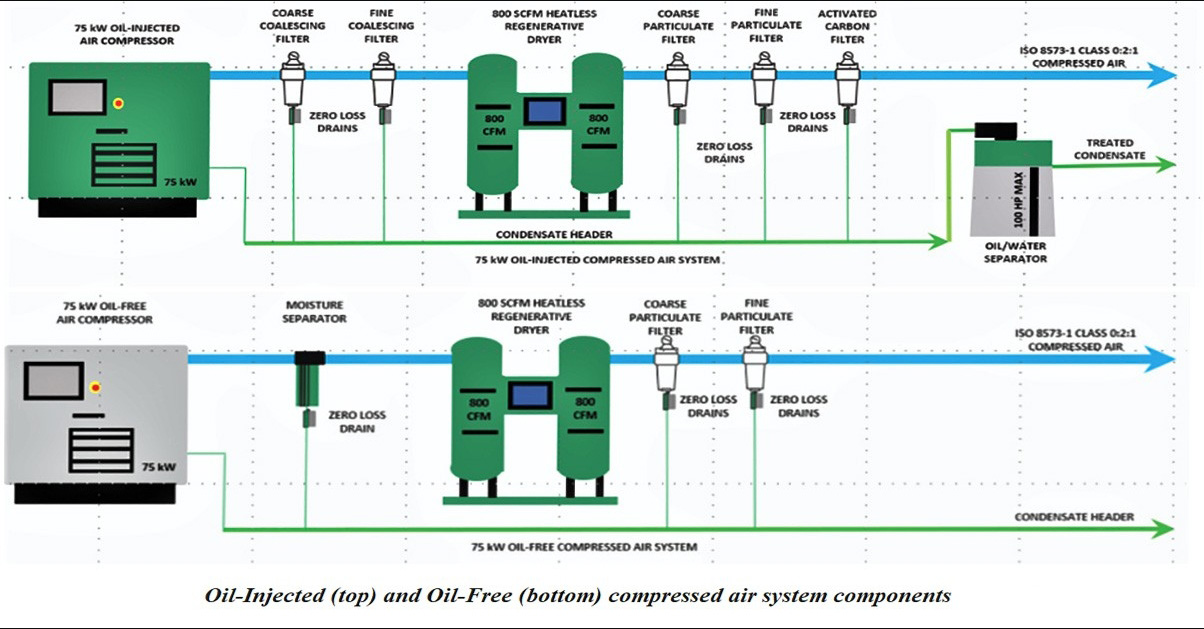
After the air is compressed, it exits the compressor with traces of oil. To ensure the air is relatively clean, an oil separator is used to separate the oil from the compressed air before it is released into the pipeline. While the oil separator is highly efficient, some residual oil might still remain in the output air, which is why these compressors are typically not suitable for applications that require completely oil-free air.
Impact of Oil on Rotor Efficiency:
The oil used in oil-injected compressors also has an impact on the rotor's efficiency. Oil acts as a sealing agent, reducing air leakage between the rotors, which in turn increases the compressor's volumetric efficiency. The lubrication reduces wear on the rotors, enabling them to operate more smoothly and for a longer period without performance degradation.
Energy Efficiency:
In high-demand applications where air consumption is constant, oil-injected compressors tend to be more energy-efficient. The presence of oil in the system enables smoother operation, reducing energy losses due to friction. These compressors are particularly well-suited for industries that require a large volume of compressed air consistently, such as construction, automotive manufacturing, and general industrial operations.
Oil Free Screw Air Compressors
In contrast, oil-free screw air compressors use advanced materials and innovative engineering to achieve lubrication without the need for oil. This enables the compressor to produce 100% oil-free air, making it essential for industries with stringent air quality requirements. The following technical aspects highlight how oil-free compressors operate:
Rotor Design and Materials:
Oil-free compressors are designed with specialized coatings or materials to reduce friction and wear between the rotors and other internal components. For instance, carbon-coated rotors or ceramic bearings are often used to create a self-lubricating effect, minimizing the need for oil.
Some oil-free compressors feature two-stage compression: The air is compressed in two distinct stages. In the first stage, the air undergoes moderate compression, and in the second stage, it is further compressed to the desired pressure. This dual-stage compression improves overall efficiency and reduces the need for high levels of friction-resisting coatings.
Some oil-free compressors feature two-stage compression: The air is compressed in two distinct stages. In the first stage, the air undergoes moderate compression, and in the second stage, it is further compressed to the desired pressure. This dual-stage compression improves overall efficiency and reduces the need for high levels of friction-resisting coatings.
Advanced Coatings and Bearing Technology:
The use of advanced bearings and seals is critical in oil-free compressors. These components are made from high-performance materials like Teflon or ceramic, which allow for smooth rotation with minimal wear. The goal is to reduce internal friction to maintain high efficiency, despite the absence of oil.
Special coatings on the rotors, like hard chrome or Teflon, also help to improve the lifespan of components and reduce friction without relying on traditional lubrication. These coatings create a smooth surface, preventing wear and tear on the compressor’s internal parts.
Special coatings on the rotors, like hard chrome or Teflon, also help to improve the lifespan of components and reduce friction without relying on traditional lubrication. These coatings create a smooth surface, preventing wear and tear on the compressor’s internal parts.
Cooling Systems:
In oil-free compressors, cooling is achieved through water-cooled systems or air-cooled systems. While water-cooled compressors can offer more efficient heat dissipation, they require a consistent supply of water, whereas air-cooled compressors are more flexible and can be used in a variety of environments without additional water resources.
The design of these compressors prioritizes efficiency in heat dissipation to prevent overheating. The lack of oil means there is a greater focus on advanced thermal management to maintain optimal operating temperatures during compression.
The design of these compressors prioritizes efficiency in heat dissipation to prevent overheating. The lack of oil means there is a greater focus on advanced thermal management to maintain optimal operating temperatures during compression.
High-Efficiency Air Quality:
Oil-free compressors are designed to ensure zero contamination in the compressed air. The rotors and compression chamber are carefully engineered to prevent any contact with oil, and the compressor delivers clean, dry, oil-free air suitable for critical applications.
The air is passed through multiple filtration systems to remove impurities before it is delivered to the end-use. These systems are essential for industries such as food and beverage, pharmaceuticals, and electronics, where even trace amounts of oil could lead to contamination and product failure.
The air is passed through multiple filtration systems to remove impurities before it is delivered to the end-use. These systems are essential for industries such as food and beverage, pharmaceuticals, and electronics, where even trace amounts of oil could lead to contamination and product failure.
Energy Efficiency:
Oil-free compressors generally have higher energy consumption when compared to oil-injected compressors, particularly in higher-pressure applications. This is due to the increased friction in the system, which requires more energy to operate.
However, recent advancements in variable speed drives (VSD) and two-stage compression technologies have helped improve the energy efficiency of oil-free compressors, making them more cost-effective in the long run.
However, recent advancements in variable speed drives (VSD) and two-stage compression technologies have helped improve the energy efficiency of oil-free compressors, making them more cost-effective in the long run.
Comparing Technical Aspects: Oil Injected vs. Oil Free
| Feature | Oil Injected Screw Air Compressors | Oil Free Screw Air Compressors |
| Lubrication | Oil used for lubrication and cooling. | No oil used; advanced coatings or materials for lubrication. |
| Cooling System | Oil aids in cooling, or air/water-cooled options are used. | Water-cooled or air-cooled systems for heat dissipation. |
| Rotor and Bearing Technology | Standard materials with oil aiding rotor efficiency and longevity. | High-performance coatings, ceramic bearings, Teflon seals. |
| Efficiency in Compression | Higher efficiency, especially at high volumes and pressures. | Lower efficiency due to friction but optimized for low-to-medium pressures. |
| Air Quality | Potential for minimal oil contamination in output air. | 100% oil-free air suitable for sensitive applications. |
| Maintenance | Regular oil changes, oil filter replacement, and separator maintenance. | More frequent component checks; replacement of bearings and seals. |
| Energy Consumption | Generally lower for heavy-duty applications. | Higher energy consumption, especially at high pressures. |
| Cost | Lower initial cost and maintenance. | Higher initial cost but no oil-related maintenance expenses. |
Applications Difference: Oil Injected Screw Air Compressor Vs. Oil Free Screw Air Compressor
Understanding the specific applications of oil-injected and oil-free screw air compressors is crucial for selecting the right compressor for your needs. The choice of compressor depends largely on the type of work, the required air quality, the level of pressure, and the industry standards. Below, we explore the ideal uses for each compressor type based on their unique features, efficiency, and air quality capabilities.
Applications of Oil Injected Screw Air Compressors
Oil-injected screw air compressors are well-suited for industrial applications where air purity is not the highest priority, and the primary concerns are reliability, efficiency, and cost-effectiveness. These compressors are typically used in applications that require high volumes of air, and they excel in environments where the air quality can tolerate minimal oil traces.
1. General Industry
Manufacturing Plants: Oil-injected compressors are commonly used in heavy manufacturing settings where large amounts of compressed air are needed for tools, pneumatic equipment, and production machinery. The oil helps improve the performance and longevity of compressors in these high-demand environments.
Construction and Mining: Oil-injected compressors are frequently deployed at construction sites and in the mining industry. They power air-driven tools such as drills, hammers, and jackhammers, where high-volume air is essential and contamination is not a critical issue.
Automotive Manufacturing: In the automotive industry, oil-injected compressors are used for assembly lines and for powering tools that require high-pressure air. These systems are effective in environments where air quality standards are not as stringent.
Construction and Mining: Oil-injected compressors are frequently deployed at construction sites and in the mining industry. They power air-driven tools such as drills, hammers, and jackhammers, where high-volume air is essential and contamination is not a critical issue.
Automotive Manufacturing: In the automotive industry, oil-injected compressors are used for assembly lines and for powering tools that require high-pressure air. These systems are effective in environments where air quality standards are not as stringent.
2. HVAC Systems
Cooling and Heating Systems: In HVAC (heating, ventilation, and air conditioning) systems, oil-injected compressors are used for air handling units and refrigeration systems. Their ability to run continuously and their energy efficiency makes them ideal for these high-pressure applications.
3. Industrial Automation
Pneumatic Tools and Systems: Oil-injected compressors are used extensively in automated production lines where tools, robots, and other machinery require a constant supply of compressed air. These systems are highly reliable and can handle the continuous operation needed in automation environments.
Packaging: In food and beverage packaging, while air quality is important, it is often not critical, and oil-injected compressors provide the necessary air volume at a lower cost compared to oil-free compressors.
Packaging: In food and beverage packaging, while air quality is important, it is often not critical, and oil-injected compressors provide the necessary air volume at a lower cost compared to oil-free compressors.
4. Heavy Equipment and Agriculture
Agricultural Equipment: Oil-injected compressors are used in various agricultural machines, from irrigation pumps to spraying systems, where high-volume and high-pressure air are required. These compressors are ideal for outdoor environments where the potential for contamination is less of a concern.
Heavy-Duty Equipment: In industries dealing with large-scale machinery and equipment, such as steel manufacturing or shipbuilding, oil-injected compressors provide the power needed to drive pneumatic actuators, tools, and lifting systems.
Heavy-Duty Equipment: In industries dealing with large-scale machinery and equipment, such as steel manufacturing or shipbuilding, oil-injected compressors provide the power needed to drive pneumatic actuators, tools, and lifting systems.
5. Compressed Air for Process Applications
Centrifugal Air Systems: In many industrial processes, oil-injected compressors are used for applications like air separation, filtration, and pneumatic conveying, where large volumes of air are required to move materials or create vacuum pressure.
Applications of Oil Free Screw Air Compressors
Oil-free screw air compressors are preferred in industries and applications that require 100% clean, dry, and oil-free air. These compressors are essential in settings where any amount of oil contamination could result in significant product loss, safety hazards, or compromised quality.
1. Food and Beverage Industry
Packaging and Processing: In the food and beverage industry, oil-free compressors are used in food processing, bottling, and packaging operations. These applications require strict hygiene standards, as oil contamination could affect the quality and safety of the food products.
Brewing and Distilling: Air used in brewing processes must be completely free of oil to avoid contamination that could affect the flavor or quality of beverages. Oil-free compressors are employed in beer brewing, wine production, and spirit distillation, ensuring the purity of the air used in fermentation and packaging.
Brewing and Distilling: Air used in brewing processes must be completely free of oil to avoid contamination that could affect the flavor or quality of beverages. Oil-free compressors are employed in beer brewing, wine production, and spirit distillation, ensuring the purity of the air used in fermentation and packaging.
2. Pharmaceutical and Medical Industry
Medical Air Systems: Oil-free compressors are critical in medical applications such as medical gas supply and dental air systems. The need for completely clean air, particularly in hospitals, clinics, and laboratories, means that oil-free compressors are often the only acceptable choice. Any trace of oil could potentially harm patients, making oil-free technology indispensable.
Pharmaceutical Manufacturing: The pharmaceutical industry demands the highest air quality standards. Oil-free air is crucial in the production of medications, vaccines, and medical devices to ensure that there is no risk of contamination during production processes or packaging.
Pharmaceutical Manufacturing: The pharmaceutical industry demands the highest air quality standards. Oil-free air is crucial in the production of medications, vaccines, and medical devices to ensure that there is no risk of contamination during production processes or packaging.
3. Electronics and Semiconductor Manufacturing
Clean Rooms and Assembly: Oil-free compressors are used in clean room environments where any contamination could compromise the quality of sensitive electronics and semiconductor components. The compressed air used in these environments must be free from contaminants, including oil particles, to avoid damaging delicate parts.
Printed Circuit Board (PCB) Manufacturing: Oil-free compressors provide clean, dry air for cleaning and testing PCBs and other electronic components. These systems are crucial for maintaining the quality and integrity of products in the highly sensitive electronics sector.
Printed Circuit Board (PCB) Manufacturing: Oil-free compressors provide clean, dry air for cleaning and testing PCBs and other electronic components. These systems are crucial for maintaining the quality and integrity of products in the highly sensitive electronics sector.
4. Automotive Industry (Precision Manufacturing)
Painting and Coating: In the automotive manufacturing process, particularly in painting and coating applications, oil-free compressors are employed to provide high-quality, clean air that prevents contamination in paint and coatings, ensuring a smooth, flawless finish.
Assembly Lines for Sensitive Components: In the manufacturing of parts like brake systems or airbags, oil-free compressors are used in precision operations that require air purity to avoid compromising the components' safety and functionality.
Assembly Lines for Sensitive Components: In the manufacturing of parts like brake systems or airbags, oil-free compressors are used in precision operations that require air purity to avoid compromising the components' safety and functionality.
5. Oil-Free Air in Energy and Environmental Applications
Wastewater Treatment: Oil-free compressors are used in aeration systems for wastewater treatment plants. Oil contamination in such systems could affect the biological processes that help treat the water, so oil-free compressors are critical in this application.
Green Energy Applications: In the field of renewable energy, such as in solar panel manufacturing and wind turbine assembly, oil-free compressors are used to ensure that the production environment remains uncontaminated. This is particularly important for solar panel cleaning and battery storage systems, where even minor contamination can affect performance.
Green Energy Applications: In the field of renewable energy, such as in solar panel manufacturing and wind turbine assembly, oil-free compressors are used to ensure that the production environment remains uncontaminated. This is particularly important for solar panel cleaning and battery storage systems, where even minor contamination can affect performance.
6. Air and Gas Compression
Medical Gas Compression: Oil-free compressors are used for the compression of medical gases such as oxygen, nitrous oxide, and nitrogen. Ensuring that the air is completely free of contaminants is vital in maintaining the purity of these gases, especially in hospitals and health facilities.
7. Petrochemical and Chemical Industry
Air Separation: In air separation units (ASUs) used for the production of gases like oxygen, nitrogen, and argon, oil-free compressors are essential. Oil-free air prevents contamination of the high-purity gases, making them indispensable in high-value applications.
Summary of Applications
| Industry | Oil Injected Screw Air Compressors | Oil Free Screw Air Compressors |
| General Manufacturing | Heavy-duty use in manufacturing tools, pneumatic systems, assembly lines | Not ideal due to air purity concerns |
| Construction and Mining | Drilling, jackhammers, compressors for construction equipment | Not typically used due to cost and energy efficiency concerns |
| Automotive | Assembly lines, tools, and spray painting | Precision assembly, painting, and coating applications |
| Food and Beverage | Packaging and processing where some oil contamination is acceptable | Packaging, brewing, and distilling where air purity is critical |
| Pharmaceuticals and Medical | General manufacturing where purity is not critical | Medical air supply, drug production, and cleanroom environments |
| Electronics and Semiconductors | Powering pneumatic tools and assembly lines | Cleanroom environments, PCB production, and sensitive assemblies |
| Energy and Environment | General industrial uses, energy production | Wastewater treatment, green energy, and clean air requirements |
| Petrochemical and Chemical | Air-driven tools and non-sensitive processes | Air separation units, gas compression, and sensitive chemical processes |
How to Choose the Right Compressor?
Selecting the appropriate air compressor for your specific needs requires careful consideration of several factors, including application requirements, air quality standards, cost-effectiveness, and maintenance needs.
1. Determine Your Air Quality Requirements
The most crucial factor in choosing the right compressor is understanding the air quality standards required for your application. The level of air cleanliness needed will heavily influence whether you should opt for an oil-injected or oil-free compressor.
Oil-Free Air: If your application demands 100% oil-free air, you must select an oil-free screw air compressor. Industries such as food processing, pharmaceuticals, electronics manufacturing, and medical facilities require completely oil-free air, as even trace amounts of oil can lead to contamination, affecting product quality, safety, and compliance with industry standards.
Examples of Applications: Medical gas systems, cleanrooms, pharmaceutical production, semiconductor manufacturing, and food packaging.
Examples of Applications: Medical gas systems, cleanrooms, pharmaceutical production, semiconductor manufacturing, and food packaging.
Minimal Oil Contamination: If the air quality standards are not as strict and slight oil contamination is acceptable, an oil-injected screw air compressor may be more suitable. These compressors are designed to provide reliable, high-volume air with minimal oil traces, which can be effectively filtered using an oil separator.
Examples of Applications: Automotive manufacturing, construction, HVAC systems, and general industrial applications.
2. Consider the Required Air Flow and Pressure
Understanding your required airflow (CFM) and pressure (PSI) is essential when choosing between compressor types. Different applications demand varying levels of performance, and compressors are optimized for specific pressure and flow ranges.
Oil-Injected Compressors: These compressors are generally better for high-flow and high-pressure applications due to their efficiency in handling large volumes of air over extended periods. They are more cost-effective for industries with high demand for compressed air.
Best for: Large-scale manufacturing, construction, heavy machinery, and industries with significant air consumption.
Best for: Large-scale manufacturing, construction, heavy machinery, and industries with significant air consumption.
Oil-Free Compressors: Oil-free compressors, while typically more expensive, are designed for precision applications where air quality and purity are the top priority. These compressors often operate efficiently at moderate pressures but may be less cost-effective for operations that require continuous high-flow, high-pressure air.
Best for: Critical applications where contamination-free air is necessary, such as in cleanroom environments or laboratory settings.
3. Evaluate the Operating Environment
The environment in which the compressor will be operating plays a significant role in the decision-making process. Factors like temperature, humidity, and dust levels can impact the compressor’s performance and lifespan.
Oil-Injected Compressors: These compressors perform well in harsh, outdoor environments or places where the air may contain dust, debris, or other particulates. The oil helps lubricate and cool the system, allowing it to operate efficiently despite exposure to external elements.
Best for: Construction sites, mines, and heavy-duty manufacturing plants, where dust and environmental factors are less of a concern.
Best for: Construction sites, mines, and heavy-duty manufacturing plants, where dust and environmental factors are less of a concern.
Oil-Free Compressors: These compressors are more suitable for controlled environments where air purity is paramount. Since they do not use oil, they are less susceptible to contamination from external factors but require more careful maintenance and attention to their operating conditions.
Best for: Cleanrooms, laboratories, and indoor environments where air quality must be maintained at high standards.
4. Assess Energy Efficiency and Running Costs
Energy consumption is a significant consideration in selecting a compressor, especially for businesses looking to keep operating costs low. Oil-injected and oil-free compressors vary in their energy efficiency, which can impact your overall operational costs.
Oil-Injected Compressors: Generally more energy-efficient for high-volume, continuous applications, oil-injected compressors benefit from the oil acting as a lubricant and cooling agent, reducing internal friction and heat. This results in lower energy consumption, especially in demanding, large-scale environments.
Best for: High-demand environments where energy costs are a concern, such as large factories or industries requiring constant compressed air.
Oil-Free Compressors: While they are typically less energy-efficient than oil-injected compressors due to the higher friction and wear on internal parts, recent advances in variable speed drives (VSD) and dual-stage compression technologies have helped improve their energy performance. However, their initial and maintenance costs remain higher, making them less attractive for applications that don’t require absolute air purity.
Best for: Applications where the premium on air quality outweighs the importance of energy savings, and where the compressor will not be in operation 24/7 at high pressures.
5. Maintenance and Longevity Considerations
Maintenance is another important factor when choosing between these two types of compressors. The maintenance requirements, service intervals, and service costs can vary significantly.
Oil-Injected Compressors: These compressors require regular oil changes, filter replacements, and maintenance of the oil separator. While they may require more frequent maintenance compared to oil-free models, the overall operating costs are lower, particularly for high-volume applications. Their longer lifespan is often attributed to the oil acting as both a lubricant and cooling agent, reducing wear and tear on the internal components.
Best for: Industrial applications with heavy-duty use, where routine maintenance can be easily integrated into existing workflows.
Oil-Free Compressors: Oil-free compressors have no oil to change, but they tend to require more maintenance on components like rotors, seals, and bearings, which are subject to higher wear due to the lack of lubrication. They also have higher initial costs and repair costs compared to oil-injected models. However, the maintenance required is typically less frequent, and the absence of oil can reduce the risk of contamination during maintenance procedures.
Best for: Critical industries where downtime and contamination must be minimized, and where the cost of maintenance is outweighed by the need for clean, dry air.
6. Total Cost of Ownership (TCO)
The total cost of ownership (TCO) encompasses not just the initial purchase cost but also factors like installation, maintenance, energy consumption, and service costs over the compressor's lifespan.
Oil-Injected Compressors: These tend to have a lower initial cost and a lower overall TCO for applications that don’t require absolute purity. Over time, the energy savings and lower maintenance costs typically make oil-injected compressors more affordable in high-demand environments.
Best for: Industries with a steady need for compressed air where air quality standards are moderate.
Oil-Free Compressors: Though the initial investment is higher, the absence of oil-related maintenance costs and the ability to deliver oil-free air make these compressors the ideal choice for environments that require high-quality compressed air. However, they generally incur higher long-term costs due to their increased energy consumption and more frequent parts replacements.
Best for: Industries where air quality is a critical factor and where long-term maintenance and service can be managed effectively.
7. Consider Manufacturer Support and Warranty
Choosing a reputable manufacturer is key to ensuring your compressor performs well throughout its lifecycle. After-sales support, warranty, and service availability can significantly impact the performance and reliability of your compressor.
KITO, a leading supplier based in China, is known for offering high-quality screw air compressors with comprehensive warranties and customer support services. Whether you choose an oil-injected or oil-free compressor, KITO provides both types with reliable performance and after-sales services, ensuring that you can maintain optimal productivity without unnecessary downtime.
Summary of the key points to consider:
| Consideration | Oil Injected Screw Air Compressor | Oil-Free Screw Air Compressor |
| Air Quality | Needs Acceptable for applications with minimal oil contamination | Essential for applications requiring 100% oil-free air |
| Airflow and Pressure | Requirements Best for high-flow, high-pressure applications | Ideal for moderate-flow, precision applications |
| Operating Environment | Suitable for harsh environments, heavy-duty applications | Best for clean, controlled environments |
| Energy Efficiency | Generally more energy-efficient for high-volume use | Less energy-efficient but improving with VSD and other technologies |
| Maintenance | Requires oil changes, filter replacement, and separator servicing | Requires rotor, seal, and bearing maintenance, no oil changes needed |
| Total Cost of Ownership (TCO) | Lower initial and long-term cost | Higher initial cost but lower maintenance cost |
| Manufacturer Support | KITO provides excellent support and reliability | KITO offers high-quality support for oil-free models as well |
Conclusion
In conclusion, the decision between an oil-injected screw air compressor and an oil-free screw air compressor ultimately depends on several key factors, including your specific air quality requirements, application demands, budget, and operating environment. Each type of compressor has its unique advantages and is tailored for different operational needs. By understanding the key differences and technical considerations, businesses can make informed choices that not only meet their immediate requirements but also provide long-term value.