Español
 العربية
 Pусский
In the intricate tapestry of modern technology, numerous components work in concert to power our industries, cool our spaces, and drive our innovations. Among these, the air compressor and the condenser stand out as crucial yet often misunderstood entities. While both are integral to a wide array of systems, their fundamental functions, the principles governing their operation, and the ultimate outcomes they achieve are distinctly different. To conflate an air compressor with a condenser is to overlook the subtle yet profound engineering that underpins their specific roles. This detailed exploration aims to dissect these two vital pieces of equipment, delving into their operational mechanics, diverse applications, performance characteristics, and the broader context of their significance in our technological landscape.
At their core, both devices interact with fluids, but the nature of this interaction and its purpose diverge significantly. An air compressor is a dynamic machine designed to take a gas – most commonly atmospheric air – and through mechanical work, reduce its volume, thereby exponentially increasing its pressure. This pressurized air then becomes a valuable source of energy or a means to achieve specific industrial processes. Conversely, a condenser is a passive heat exchanger, its primary function being to induce a phase change in a substance, typically from a gaseous to a liquid state. This transformation is achieved not through mechanical compression of the substance itself (though pressure and temperature are related) but by facilitating the transfer of heat away from the gas, causing it to cool below its saturation point.
Unraveling the Primary Functions: The Art of Compression vs. the Science of Condensation
The operational narratives of air compressors and condensers begin with fundamentally different objectives. An air compressor embarks on a cycle of intake, compression, and delivery. It draws in air, a readily available mixture of gases, and then, through the orchestrated movement of internal components such as pistons, rotary screws, vanes, or scrolls, it forces this air into a smaller volume. This mechanical reduction in volume directly translates to a substantial increase in the air's pressure. The resulting high-pressure air is then channeled and utilized to power a diverse range of tools and machinery, from the delicate airbrushes of artists to the robust jackhammers of construction workers.
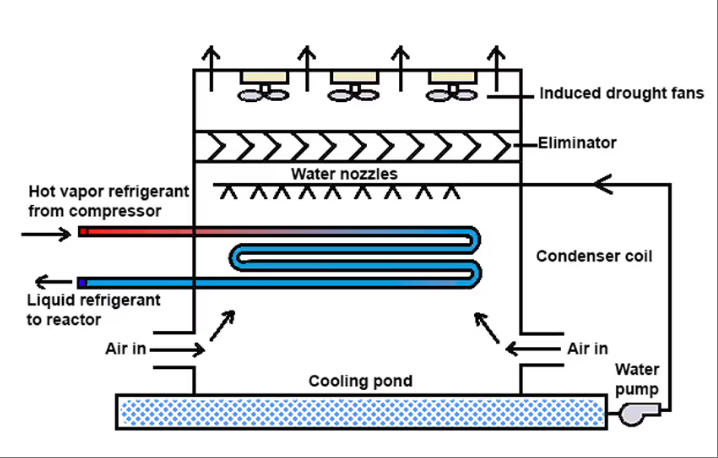
In contrast, the condenser's function revolves around the principles of thermodynamics and heat transfer. It receives a substance that is in its gaseous state, often at a relatively high temperature and pressure. The key to the condenser's operation lies in its ability to provide a pathway for heat to escape from this gas to a cooler surrounding medium. This medium can be ambient air flowing over finned tubes, water circulating through a shell and tube arrangement, or even the evaporation of water in specialized evaporative condensers. As the hot gas comes into thermal contact with the cooler medium, heat energy flows from the gas to the medium. This loss of heat causes the temperature of the gas to drop. When the temperature falls below the saturation point corresponding to the gas's pressure, a phase transition occurs, and the gas condenses into a liquid. The condenser's output is thus a liquid form of the initial gaseous substance, ready for the next stage of a thermodynamic cycle or for collection and further use.
The Working Medium: From Ambient Air to Diverse Vapors
The primary working medium further distinguishes these two devices. Air compressors predominantly work with atmospheric air, a readily available and compressible resource. However, their versatility extends to compressing other gases like nitrogen for industrial processes, natural gas for transportation or storage, and even specialized gas mixtures for laboratory or medical applications. The focus remains on manipulating the pressure and flow rate of the gas itself.
Condensers, on the other hand, interact with a broader spectrum of substances that exist in a gaseous or vapor phase. In the realm of air conditioning and refrigeration, they are indispensable for condensing refrigerants – specialized fluids engineered for their heat absorption and release properties. In power generation, particularly in thermal power plants, condensers play a critical role in converting exhaust steam from turbines back into liquid water, allowing it to be efficiently pumped back to the boiler to generate more steam, thus completing the thermodynamic cycle. Chemical processing plants utilize condensers to recover valuable liquids from vapor streams or to separate different components of a mixture through controlled condensation. Even in the seemingly simple process of dehumidification, a condenser cools air below its dew point, causing water vapor to condense into liquid water, thereby reducing humidity.
A Tale of Two Applications: Powering the Physical World vs. Enabling Thermodynamic Cycles
The applications of air compressors and condensers highlight their fundamentally different roles in our technological landscape. Air compressors are the driving force behind a vast array of tools and industrial processes that require mechanical power. From the precise control of pneumatic robots in automated factories to the sheer force of jackhammers breaking concrete, compressed air provides a versatile and often indispensable power source. They are integral to the operation of spray painting equipment, sandblasting tools, and various machinery in manufacturing sectors ranging from food and beverage to pharmaceuticals. Moreover, compressed air plays a crucial role in controlling HVAC systems through dampers and actuators, and it is essential for the braking systems of large vehicles and for inflating tires across the transportation industry. Even in medical settings, air compressors provide clean air for respirators and other vital medical devices.
Condensers, in contrast, are the unsung heroes that enable crucial thermodynamic cycles. Without condensers, the cooling we take for granted in our homes, offices, and vehicles would be impossible. They are the heat rejection points in air conditioning and refrigeration systems, allowing the refrigerant to shed the heat absorbed from the conditioned space and transition back into a liquid to repeat the cooling cycle. In the generation of electricity in thermal power plants, condensers are vital for maximizing efficiency by creating a vacuum at the turbine exhaust, allowing for greater expansion of the steam and converting it back into water for reuse. Chemical industries rely on condensers for separating and purifying various substances, while distillation processes, crucial for producing everything from fuels to pharmaceuticals, depend on the controlled condensation of vaporized liquids. Even the simple act of dehumidifying a room relies on the condenser to extract moisture from the air.
Exploring the Diverse Architectures: Designs Tailored to Function
The physical designs of air compressors and condensers reflect their distinct operational requirements. Air compressors come in various architectures, each suited for different pressure and flow rate demands. Reciprocating compressors, with their piston-cylinder arrangements, are common for smaller, intermittent uses. Rotary screw compressors offer efficiency and continuous operation for larger industrial needs. Centrifugal compressors are designed for massive airflow rates in very large-scale applications. Rotary vane and scroll compressors provide more specialized solutions with varying degrees of efficiency and noise characteristics.
Condensers, on the other hand, are primarily categorized by the medium used to remove heat. Air-cooled condensers, with their characteristic fins, rely on the flow of ambient air for heat transfer and are ubiquitous in residential AC outdoor units. Water-cooled condensers, often employing shell and tube or shell and coil designs, offer more efficient heat transfer and are used in larger commercial and industrial systems where a water source is available. Evaporative condensers enhance heat transfer by combining air and the evaporation of water over the condenser coils. Plate heat exchangers are increasingly finding applications as condensers due to their compact size and efficient heat transfer capabilities.
Performance Benchmarks: Measuring Different Outcomes
The performance of air compressors and condensers is evaluated using different metrics that align with their respective functions. Air compressor performance is characterized by its maximum achievable pressure (measured in PSI or bar) and its flow rate (measured in CFM or LPS), which dictates the volume of compressed air delivered. The duty cycle, indicating the permissible continuous operating time, is also a crucial performance parameter.
For condensers, the key performance indicator is the heat rejection rate (measured in BTU/hour or kW), which signifies the amount of heat the condenser can effectively dissipate. The condensing temperature, the temperature at which the gas transitions to a liquid at a given pressure, and the approach temperature, the temperature difference between the condensing refrigerant and the leaving cooling medium, are also critical indicators of a condenser's efficiency and effectiveness.
Energy Considerations: Efficiency in Compression vs. Heat Rejection
Energy efficiency is a critical consideration for both air compressors and condensers, albeit with different implications. For air compressors, energy consumption constitutes a significant portion of their operating costs. The efficiency of an air compressor is influenced by its type, the motor driving it, and the way it is operated. Implementing variable speed drives (VSDs) to match the compressor's output to the actual demand can lead to substantial energy savings. Minimizing air leaks and operating at the lowest necessary pressure are also crucial for optimizing energy use.
In condensers, efficiency translates to the ability to effectively reject heat with minimal energy input (primarily for fans or pumps associated with the cooling medium). A more efficient condenser allows the compressor in a refrigeration cycle to operate at a lower discharge pressure, which in turn reduces the energy consumed by the compressor. Factors such as the heat transfer surface area, the flow rate and temperature of the cooling medium, and maintaining clean heat transfer surfaces are paramount for maximizing condenser efficiency.
Integration into Larger Systems: Different Roles, Different Contexts
Air compressors and condensers are integral components of vastly different types of systems. Air compressors are found as standalone units powering tools in workshops and homes, integrated into complex industrial machinery and automated production lines, forming crucial parts of vehicle braking and suspension systems, and driving pneumatic control systems in various applications.
Condensers, on the other hand, are typically found within thermodynamic cycles. They are the heat rejection components in the outdoor units of air conditioning systems, essential parts of refrigeration systems in supermarkets and industrial cold storage facilities, crucial elements in power plants for steam condensation, and vital in chemical processing plants for vapor recovery and separation processes.
Conclusion: Distinct Yet Indispensable Components of Modern Technology
In conclusion, while the air compressor and the condenser are both essential components in a wide array of technological systems, their functions and operational principles are fundamentally distinct. An air compressor is a power-generating device that increases the pressure of air (or other gases) to provide a source of energy or to facilitate specific industrial processes. A condenser, conversely, is a heat exchanger that induces a phase change in a substance by removing heat, playing a crucial role in thermodynamic cycles such as refrigeration and power generation.
Understanding these fundamental differences is paramount for engineers, technicians, and anyone involved in the design, operation, or maintenance of systems that utilize these technologies. While one focuses on manipulating the kinetic energy of gas molecules through compression, the other focuses on manipulating their thermal energy to induce a change of state. Both are indispensable pillars of modern technology, each contributing in its unique way to the comfort, productivity, and advancement of our society. Recognizing their distinct roles allows for more effective system design, optimized energy utilization, and a deeper appreciation for the intricate engineering that underpins the technologies we rely on daily.