Español
 العربية
 Pусский
In the realm of tools and equipment designed to manipulate air, the terms "air compressor" and "inflator" frequently surface, often leading to a degree of overlap in understanding, particularly for those less familiar with their specific functionalities. While both devices ultimately deal with increasing air pressure, their design philosophies, operational capabilities, and intended applications are markedly distinct. To consider them interchangeable would be akin to confusing a multi-tool with a dedicated screwdriver – both can address certain tasks, but their core purpose and overall versatility differ significantly. This comprehensive exploration aims to dissect the fundamental characteristics, operational nuances, and diverse applications of air compressors and inflators, providing an in-depth understanding of their individual strengths and limitations.
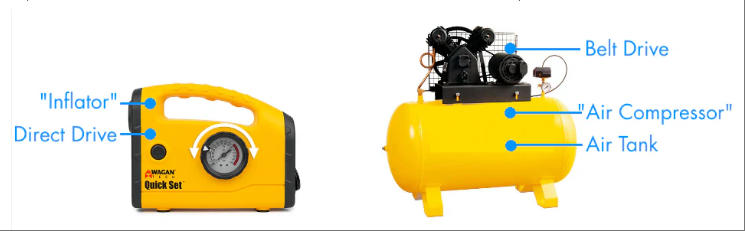
At their most basic level, both an air compressor and an inflator take ambient air and increase its pressure. However, the similarity largely ends there. An air compressor is generally engineered as a more robust and versatile machine, capable of generating significantly higher pressures and delivering larger volumes of compressed air. Its design often incorporates features like storage tanks and pressure regulation systems, making it suitable for powering a wide array of pneumatic tools and supporting various industrial and commercial processes that demand a sustained supply of high-pressure air. Conversely, an inflator is specifically designed with the singular purpose of inflating objects such as tires, sports balls, and air mattresses. Its design prioritizes portability, ease of use, and the ability to quickly deliver a moderate volume of air at lower pressures suitable for these specific inflation tasks.
Unraveling the Core Functionality: Power Generation vs. Volume Delivery
The fundamental operational principles of air compressors and inflators reflect their divergent design goals. An air compressor typically operates through a cyclical process of air intake, compression, and delivery. Ambient air is drawn into a compression chamber, where its volume is mechanically reduced through the action of pistons, rotary screws, vanes, or other sophisticated mechanisms. This reduction in volume results in a substantial increase in pressure. Many air compressors are equipped with a storage tank, which acts as a reservoir for the compressed air, allowing for intermittent high-demand applications without the compressor having to run continuously. The stored compressed air is then delivered through hoses and fittings to power various tools or machinery, often with the pressure regulated to match the specific requirements of the application.
In contrast, an inflator is designed with a more direct approach focused on delivering a sufficient volume of air at a pressure suitable for inflation. While it also employs a compression mechanism to increase air pressure, the compression ratio is typically lower than that of a full-fledged air compressor. Inflators often lack a significant storage tank and are designed to directly output air into the object being inflated. The emphasis here is on achieving a sufficient flow rate to quickly inflate items to their desired pressure, rather than sustaining a high-pressure output for continuous tool operation.
Pressure and Volume Output: Defining the Performance Gap
The most significant differentiating factor between air compressors and inflators lies in their pressure and volume output capabilities. Air compressors are engineered to generate a broad spectrum of pressures, ranging from relatively moderate levels suitable for some inflation tasks to extremely high pressures required for heavy-duty industrial applications, sometimes reaching hundreds or even thousands of pounds per square inch (PSI). Their volume output, measured in cubic feet per minute (CFM) or liters per second (LPS), is also substantial and varies greatly depending on the size and capacity of the compressor, allowing for the continuous operation of power-hungry pneumatic tools. Air compressors often feature pressure regulators that enable users to precisely control the output pressure to match the specific requirements of different tools and applications.
Inflators, on the other hand, operate within a much narrower and generally lower pressure range. They are designed to provide pressures typically sufficient for inflating car tires (ranging from 30 to 50 PSI, with higher pressures for trucks and specialized vehicles), sports balls (around 8 to 12 PSI), and air mattresses (requiring very low PSI). While some high-performance portable inflators can reach higher pressures for inflating bicycle tires or certain recreational equipment, their primary focus remains within these lower to medium pressure ranges. The volume output of inflators is usually tailored to the specific inflation tasks they are designed for, prioritizing the speed at which an object can be inflated rather than the sustained delivery of large volumes of high-pressure air. Some inflators may also feature preset pressure settings for common inflation tasks, simplifying their operation.
Portability and Size: Convenience vs. Capability
Portability and size are also key distinguishing characteristics. Air compressors come in a wide array of sizes, ranging from small, portable units like pancake or hotdog compressors, suitable for DIY tasks and light inflation, to large, stationary industrial behemoths that require dedicated space and are not easily moved. While portability is a feature of some air compressors, it often comes with a trade-off in terms of power and storage capacity.
Inflators, in contrast, are inherently designed for maximum portability. They are typically lightweight and compact, making them easy to store in car trunks, backpacks, or garage shelves. Many inflators are handheld or have a small footprint, emphasizing ease of transport and use in various locations, whether it's inflating a flat tire on the roadside or topping off a basketball at the park.
Power Source: Adapting to Different Environments
The power sources for air compressors and inflators also reflect their intended use cases. Larger and more powerful air compressors predominantly rely on AC power (120V or 240V) to deliver the necessary energy for sustained high-pressure operation. While some smaller portable air compressors may offer battery power for limited use in situations where AC power is unavailable, this is less common. Industrial-grade compressors often require three-phase power for their high demands.
Inflators, on the other hand, offer a more versatile range of power options to enhance their portability and convenience. AC-powered models are available for home or garage use, while DC-powered (12V) models that can be plugged into a car's cigarette lighter socket are extremely popular for roadside emergencies and on-the-go inflation. Manual pump inflators, such as foot pumps and hand pumps, provide a completely portable and non-electrical solution for low-pressure inflation needs. Increasingly, battery-powered inflators are gaining popularity for their cordless convenience, offering a balance between portability and ease of use.
Diverse Applications: Beyond the Obvious
The applications of air compressors extend far beyond simple inflation tasks, highlighting their versatility as a power source. They are the workhorses behind a vast array of pneumatic tools used in construction, manufacturing, and automotive industries, powering everything from drills and grinders to nail guns and spray painters. In industrial settings, air compressors operate machinery, drive automation systems, and are integral to packaging equipment. They also play a crucial role in HVAC systems, controlling dampers and actuators for airflow management. Specialized air compressors are even used in the medical field to provide breathable air for certain medical devices. While some smaller portable air compressors can indeed be used for inflation, it is often not their primary design focus.
Inflators, as their name suggests, are primarily and often exclusively designed for inflation tasks. Their core application lies in inflating tires for various vehicles, from cars and motorcycles to bicycles and trucks. They are also essential for inflating sports equipment like basketballs, footballs, and soccer balls, as well as recreational items such as air mattresses, inflatable boats, and pool floats. DC-powered inflators are particularly valuable for emergency use, providing a quick and convenient way to inflate a flat tire on the roadside, enhancing safety and mobility.
Cost Considerations: Reflecting Capability and Complexity
The cost of air compressors and inflators varies significantly, reflecting their different capabilities and complexities. Air compressors generally represent a higher initial investment, with prices ranging from a few hundred dollars for basic portable units to thousands or even tens of thousands of dollars for high-capacity industrial-grade compressors. The cost is influenced by factors such as size, power output, storage capacity, features, and brand reputation.
Inflators, being simpler in design and focused on a narrower range of applications, are generally much more affordable. Basic manual pumps can cost under $20, while even high-performance portable electric inflators typically range from a few tens to a couple of hundred dollars. The cost reflects their less complex engineering and more specific functionality.
Noise Levels: A Matter of Power vs. Convenience
Noise levels are another notable difference. Larger air compressors, especially those with powerful motors and high-pressure output, can generate significant noise, often ranging from 70 decibels to over 90 decibels. In industrial environments, hearing protection is often mandatory when operating or being near air compressors. While quieter models are available, they often come at a premium.
Inflators, on the other hand, generally operate at lower noise levels, typically in the range of 60 to 80 decibels. Manual inflators are virtually silent. For portable electric inflators designed for consumer use, noise level is often a consideration in the design to enhance user comfort.
Maintenance Requirements: Simplicity vs. Complexity
The maintenance requirements for air compressors are generally more involved compared to inflators. Oil-lubricated air compressors require regular oil changes, along with periodic replacement of air intake and oil filters. Draining condensate from the storage tank is also essential to prevent rust and corrosion. Additionally, regular inspection of belts, hoses, and fittings is necessary to ensure safe and efficient operation.
Inflators, particularly electric and manual models designed for inflation tasks, typically require simpler or even minimal maintenance. Electric inflators often only need to be kept clean, while manual pumps require little to no maintenance. Durability and ease of use are often prioritized over complex maintenance schedules for these devices.
Conclusion: Selecting the Right Tool for the Task at Hand
In conclusion, while both air compressors and inflators serve to increase air pressure, their fundamental design, operational capabilities, and intended applications are distinctly different. Air compressors are versatile power sources capable of generating high pressures and delivering significant air volumes for a wide range of tasks beyond just inflation. Inflators, conversely, are specialized devices optimized for portability, ease of use, and the efficient inflation of specific objects at lower pressures.
The choice between an air compressor and an inflator ultimately hinges on the specific needs of the user. For powering pneumatic tools, supporting industrial processes, or requiring a sustained supply of high-pressure air, an air compressor is the indispensable tool. However, for simple and portable inflation needs, an inflator offers a more practical, cost-effective, and user-friendly solution. Understanding these key distinctions ensures that the right tool is selected for the job, maximizing efficiency and effectiveness.
To further contextualize this discussion, let's consider the broader industrial landscape and the role of companies like China KITO. While KITO's primary focus, as evident from their website, lies in the manufacturing and supply of lifting equipment such as chain hoists, wire rope hoists, and cranes, their expertise in producing robust and reliable mechanical equipment indirectly connects to the world of air compression. In many industrial applications where KITO's lifting solutions are employed, air compressors often play a crucial supporting role. Pneumatic tools, powered by compressed air, are frequently used for the installation, maintenance, and repair of heavy machinery, including lifting equipment. The reliability and efficiency that KITO emphasizes in their products are also critical considerations in the selection of industrial-grade air compressors that power these auxiliary tools. While KITO may not directly manufacture consumer-grade inflators, their understanding of industrial demands and their commitment to quality manufacturing place them within an ecosystem where the need for dependable compressed air solutions, often provided by larger air compressor systems, is paramount. The synergy between heavy lifting equipment and the pneumatic tools that support its use underscores the diverse applications and importance of air compression technology in the broader industrial context.