Español
 العربية
 Pусский
When you are in the market for an air compressor, you may be faced with the choice between them: belt drive or direct drive compressor. Although KITO can supply these good quality air compressors, you also should understand their differences and their respective advantages.
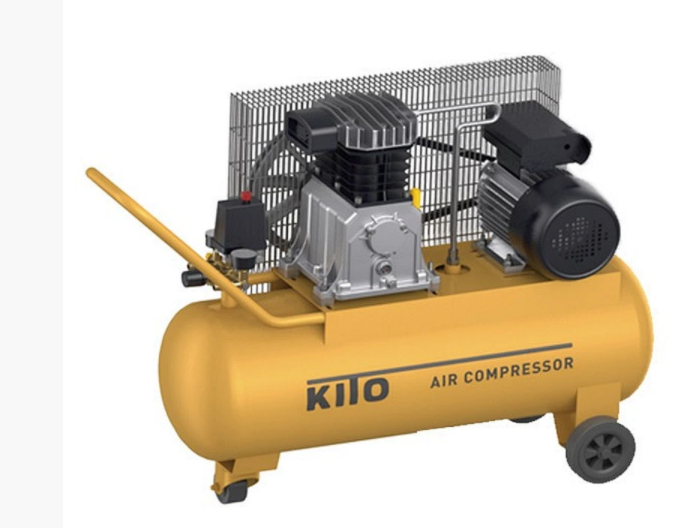
A belt driven air compressor is a type of air compressor that operates using a belt and pulley system to drive the compressor's pump. The belt is attached to the air compressor motor and to the air pump that operates the pistons or rotors. As the air compressor motor turns, it powers the belt, which transfers power to the air end via a pulley system. The pulley size determines the maximum pressure (PSI) and airflow (CFM) capacity for the air compressor. Most piston air compressors are belt driven.
A direct driven air compressor is a type of air compressor where the motor is directly coupled or integrated with the compressor's pump without the use of a belt or pulley system. As the motor turns, the crankshaft moves the pistons (for a reciprocating air compressor) through a coupling that turns the rotors (for a rotary-screw air compressor). The speed of the air pump, and thus the airflow (CFM), is directly determined by the speed of the motor (RPM). The mechanism for direct-drive air compressors is very simple with minimal moving parts. Most air compressors over 50 HP are direct-drive.
The technology
One of the first things to remember is that belt drive and direct drive versions are available for both rotary screw air compressors and piston compressors. Each option works effectively and can be beneficial to your needs, but they are very different. A belt drive compressor consists of a belt that is connected to the motor of the compressor pump. When the motor runs, the belt turns, powering the pump to your air compressor. When using a direct drive air compressor, the crankshaft is connected directly to the compressor's motor.
The benefits that matter to you
It’s hard to say which is better. But the choice between a direct drive compressor and a belt drive compressor depends on your specific priorities and requirements. If your main considerations are reliability, simplicity of operation, cost efficiency, and power, then a direct drive compressor is likely the better choice for you. On the other hand, if you require the ability to adjust speed and power, a belt drive compressor may be a more suitable option. Additionally, provided it is adequately lubricated, a belt drive compressor will run with greater smoothness and consequently produce less noise, making it an excellent selection for environments where noise levels are a significant concern.
The choice of compressor depends on several critical factors:
Usage Frequency: Consider how often you'll use the compressor. Will it run continuously, or will there be frequent starts and stops?
CFM Requirements: Determine your peak CFM (Cubic Feet per Minute) needs. How much air will you use during a shift or over the course of a day?
Required PSI: What PSI (Pounds per Square Inch) do you need to maintain at your specified CFM? Are these pressure and flow rate requirements variable?
For high CFM applications with continuous use, a direct drive rotary screw compressor is typically the preferred choice. Larger air compressors, typically 50 HP and above, are generally only available as direct drive models. These direct-drive compressors are known for their durability and reliability, making them ideal for continuous operation and high CFM demands.
Conversely, if your CFM requirements are more modest and you anticipate the possibility of adjusting PSI and CFM ratings for your compressor in the future, a belt-driven compressor may be a suitable option. This flexibility is especially valuable when considering potential changes in your compressed air needs.
Available Budget
When assessing the cost considerations between direct-drive and belt-drive compressors, two primary factors must be taken into account: initial costs and lifetime costs.
In terms of initial expenses, belt-drive compressors are typically more budget-friendly than direct-drive compressors with equivalent horsepower and CFM ratings. If your objective is to manage capital expenditures effectively, opting for a belt-drive compressor may be the prudent choice.
Nonetheless, it's important to note that a direct-drive compressor is likely to yield lower total lifetime costs due to reduced maintenance expenses and an extended expected service life. With proper care, a direct-drive compressor can reliably serve you for many years. Moreover, direct-drive compressors exhibit heightened efficiency, leading to lower energy costs (as detailed below).
Air Compressor Efficiency
When it comes to efficiency, direct-drive compressors excel. This is attributed to the more efficient transfer of power through the drive mechanism compared to belt and pulley systems. Even when a belt-drive compressor is perfectly calibrated, some energy is lost due to friction, heat, and belt slippage. The enhanced efficiency of direct-drive compressors translates into decreased energy expenses.
Environmental Conditions
For compressors operating in challenging environments, direct drive is the preferable choice. Belt-driven compressors can be highly sensitive to temperature fluctuations, extremes, and exposure to corrosive substances, including salt or chemicals. Operating a belt-drive compressor outdoors or in unfavorable indoor conditions can result in reduced belt life, increased downtime, and higher maintenance requirements. These conditions may also diminish the overall lifespan of the machine. In contrast, the simpler mechanism of a direct-drive compressor better withstands harsh conditions.
Maintenance
In terms of maintenance considerations, direct drive takes the lead once more. Direct-drive compressors necessitate less hands-on maintenance as there are no belts to inspect and replace. However, it's essential to acknowledge that when maintenance is required for a direct-drive compressor, it may be costlier and demand specialized service. Factors to ponder include whether you prefer in-house maintenance or intend to outsource air compressor preventative maintenance. Additionally, consider whether your maintenance team has the requisite time and expertise for frequent belt inspections and replacements. Evaluate the cost of maintenance related downtime in your facility, and whether compressor shutdowns are significant or if the compressor frequently remains idle. The answers to these questions will shed light on the maintenance implications tied to your compressor selection.
As you can see, as long as you go into your compressor selection with a good idea of what it will be used for, the decision regarding belt drive versus direct drive practically makes itself. Not sure which type of air compressor is right for you? For more information, just contact KITO.