Español
 العربية
 Pусский
Whether you find yourself in the shoes of a homeowner, contractor, or mechanic, it's likely that you've encountered the ongoing debate surrounding oil lubricated versus oil free air compressors, leaving you pondering, "What truly sets them apart?"
The landscape of information and technology evolves continually, and while the 'oil vs. oil free' question endures, the arguments in favor of each may not always align with these advancements.
Let's embark on a journey to demystify this debate, separating the factual insights from misconceptions. Armed with a deeper understanding of both sides, you'll be well prepared for your next discussion when someone begins to advocate for the merits of one compressor over the other.
What Is An Oil Free Air Compressor?
An oil free air compressor is a type of air compressor that does not use oil in the compression chamber. These compressors have gained popularity in various industrial applications due to their clean, efficient, and low maintenance operation.
What Is An Oil Lubricated Air Compressor?
An oil lubricated air compressor is a type of air compressor that uses oil in its operation. This oil serves various functions within the compressor and is commonly used in many industrial and commercial applications.
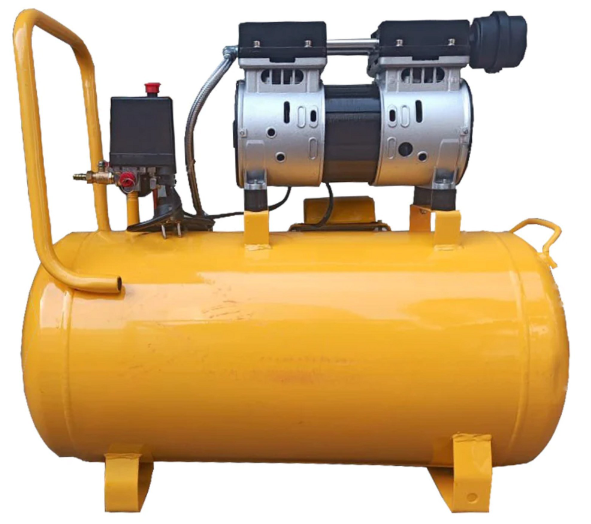
Differences Between Oil Free Air Compressor And Oil Lubricated Air Compressor
The differences that separated oil lubricated and oil free compressors years ago aren't the same today, even though the terminology hasn't changed that much. However, there seems to be unnecessary confusion because some people compare all different types of compressors at once when in fact the debate, at its core, is really about the most common type.
1. Lubrication:
Oil Free Air Compressor:
These compressors do not use oil in the compression chamber.
Lubrication free components are employed, such as self lubricating materials and non metallic materials.
Suitable for applications where oil contamination is a concern, such as in the food, pharmaceutical, and electronics industries.
Oil Lubricated Air Compressor:
Oil is used for lubricating moving parts, such as pistons and bearings, within the compressor pump.
Lubrication is necessary to reduce friction and wear on components.
Not suitable for applications where oil free air is required, as oil contamination can be a concern.
2. Contaminant Free Air:
Oil Free Air Compressor:
Provides completely oil free compressed air, making it ideal for applications where air quality is critical.
Oil Lubricated Air Compressor:
There is a potential for oil carryover, which can contaminate the compressed air. Oil separators and coalescing filters are used to reduce oil content, but they may not provide completely oil free air.
3. Maintenance:
Oil Free Air Compressor:
Generally, oil free compressors require less maintenance compared to oil lubricated compressors.
Minimal oil changes and filter replacements are needed.
Oil Lubricated Air Compressor:
Requires regular oil changes and filter replacements to maintain proper lubrication and prevent oil contamination of the compressed air.
4. Efficiency:
Oil Free Air Compressor:
Typically less energy efficient compared to oil lubricated compressors.
Lower efficiency may lead to higher operational costs over time.
Oil Lubricated Air Compressor:
Generally more energy efficient and provides better performance in high demand applications.
5. Noise Levels:
Oil Free Air Compressor:
Tends to be quieter during operation due to reduced friction and vibration.
Oil Lubricated Air Compressor:
Can be noisier due to the mechanical parts in contact with oil.
6. Initial Cost:
Oil Free Air Compressor:
Tends to have a lower upfront cost compared to oil lubricated compressors.
Oil Lubricated Air Compressor:
Typically has a higher initial cost due to the added complexity of oil lubrication systems.
7. Applications:
Oil Free Air Compressor:
Ideal for industries where oil free air is crucial, such as food processing, pharmaceuticals, electronics manufacturing, and clean rooms.
Suitable for applications where air quality is a priority.
Oil Lubricated Air Compressor:
Commonly used in various industrial settings, construction, automotive repair, and other applications where oil contamination in the air is not a critical concern.
Suited for continuous or heavy duty applications.
Is Oil Or Oil Free Better?
It’s hard to sat which is better, but you can think about you situation then to choose a right one.
Oil lubricated compressors last longer
The chief argument these days is that oil free compressors can't match the longevity and dependability of oil lubed compressors and therefore don't offer the same value. Routine maintenance and regular oiling tended to make oiled compressors more durable and have a longer lifespan than the first versions of oil free machines. Although that might've been the case before oil free technology took off, it just isn't true anymore. Today's oilless compressors run cooler and come better protected than ever before.
Oil free compressors are a lot louder
Again, the oil free compressors of yesteryear were unquestionably loud, but today's designs feature direct drive, dual piston (duplex) pumps and advanced sound reducing technologies that make oilless compressors much softer than their oiled, shouty brethren.
Oil lubricated compressors operate at lower temperatures and are built to endure harsh conditions. In contrast, oil free compressors feature dual pump designs, enabling them to achieve the desired CFM/PSI with only half the RPM. These compressors incorporate heat dissipating aluminum cylinders to maintain cooler running temperatures. Notably, oilless compressors are favored in extremely cold environments since there is no concern about the oil congealing. Conversely, oil lubricated compressors may be preferred when operating in exceptionally hot and humid conditions because they can efficiently dissipate heat during their duty cycle and are more resistant to rust accumulation.
In fact, oilless compressors are preferred in extreme cold because there's no worry about the oil turning to sludge. On the other hand, oiled compressors may be desired if working in extreme heat and humidity, because they can dissipate heat more quickly in a given duty cycle and resist rust build up.
After years of accumulated production, research and development experience, KITO has achieved the best production process standards. Through strict inspection and monitoring throughout the entire process from trial production to finished products, we ensure that the quality of them meets the standards and customers’ requirements.