Español
 العربية
 Pусский
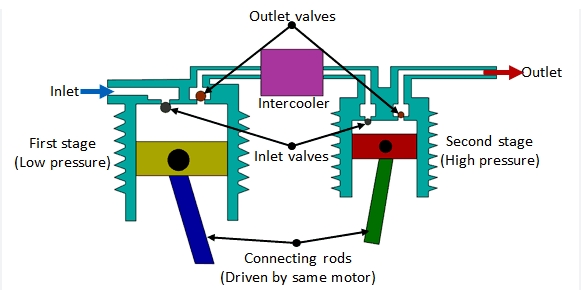
In the realm of fluid compression, where the goal is to increase the pressure of a gas or vapor, the design of the compressor plays a pivotal role in determining its efficiency, capabilities, and overall suitability for a given application. While single-stage compressors offer simplicity and cost-effectiveness for lower pressure requirements, multi-stage compressors emerge as the preferred choice when higher pressures or enhanced efficiency are paramount. These sophisticated machines achieve compression in a series of sequential steps, each occurring within a separate compression chamber. This multi-step approach offers a suite of compelling advantages, but it also introduces certain complexities and drawbacks that must be carefully considered. China KITO delves into the intricate world of multi-stage compressors, providing a thorough and in-depth analysis of their benefits and limitations, addressing the concerns of users across various industries.
The Upside: Unveiling the Advantages of Multi-Stage Compression
Multi-stage compressors, by their very design, offer several key advantages over their single-stage counterparts, making them indispensable in numerous high-demand applications:
Elevated Efficiency Through Staged Compression: The cornerstone of the multi-stage compressor's appeal lies in its enhanced energy efficiency. This improvement stems from the fundamental principle of dividing the total pressure ratio required for the application into smaller pressure ratios across multiple compression stages. The thermodynamic work required to compress a gas is not linear with the pressure ratio; rather, it increases more significantly at higher ratios. By breaking down a large pressure increase into several smaller, more manageable steps, each stage operates more efficiently. This staged compression minimizes the energy wasted in overcoming high pressure differentials within a single cylinder.
Furthermore, multi-stage compressors almost invariably incorporate intercoolers (or aftercoolers between stages, depending on the fluid and application). These heat exchangers play a critical role in removing the heat generated during the compression process in each stage. As a gas is compressed, its temperature naturally increases. This elevated temperature increases the volume of the gas, meaning that subsequent compression stages would have to work harder to achieve the desired pressure. Intercooling mitigates this issue by cooling the fluid between stages, leading to a reduction in its volume and temperature before it enters the next compression chamber. This results in:
* Reduced Work of Compression: Compressing a cooler, less voluminous fluid requires significantly less energy input for each subsequent stage. This cumulative effect across multiple stages leads to a substantial reduction in the overall work needed to achieve the final pressure compared to a single-stage compressor.
* Closer Approximation to Isothermal Compression: Isothermal compression, where the temperature of the gas remains constant during compression, is the theoretically most efficient process. While impossible to achieve perfectly in practice, multi-stage compression with effective intercooling brings the actual process closer to this ideal by removing the heat of compression between stages.
* Improved Volumetric Efficiency: The lower temperatures achieved through intercooling contribute to a denser intake fluid for the subsequent stages. Additionally, the reduced pressure ratios per stage minimize the re-expansion of any trapped gas in the clearance volume of the cylinders. These factors collectively lead to a higher volumetric efficiency, meaning the compressor delivers a greater volume of compressed fluid relative to its physical displacement.
Reaching Higher Pressure Plateaus: Multi-stage compressors are the workhorses of applications demanding significantly higher discharge pressures. Unlike single-stage compressors, which are limited by the mechanical stresses and thermal constraints associated with achieving very high pressure ratios in a single step, multi-stage designs can incrementally increase the pressure across several stages. Each stage builds upon the pressure achieved by the previous one, allowing for the cumulative effect of multiple compression steps to reach far greater final pressures. Two-stage compressors are commonly used for moderate high-pressure applications, while three or more stages are employed for achieving very high pressures in industries like gas processing, chemical manufacturing, and high-pressure air supply.
Cooler Operation for Enhanced Reliability: The integration of intercoolers in multi-stage compressors not only boosts efficiency but also results in significantly lower discharge temperatures compared to single-stage compressors operating at similar pressure ratios. These cooler operating temperatures offer several critical benefits:
* Improved Safety and Reliability: Lower discharge temperatures reduce the thermal stress on the compressor components, minimizing the risk of overheating, material fatigue, and premature failures. This contributes to the overall safety and reliability of the compressor system.
* Reduced Lubricant Degradation: Excessive heat can cause the lubricating oil within the compressor to break down, lose its viscosity, and become less effective. The cooler operating temperatures in multi-stage compressors help maintain the integrity of the lubricant for longer periods, extending its lifespan and ensuring proper lubrication of moving parts.
* Enhanced Compressed Air Quality: In air compression applications, lower discharge temperatures reduce the amount of moisture that remains in vapor form within the compressed air. This makes it easier to remove the moisture downstream using aftercoolers and separators, resulting in a higher quality of compressed air that is less likely to cause corrosion or damage to pneumatic equipment.
Minimizing Leakage Losses: In any positive displacement compressor, leakage past seals (such as piston rings in reciprocating compressors) can lead to efficiency losses. In a multi-stage compressor, the pressure difference that each set of seals has to withstand is significantly lower compared to a single-stage compressor achieving the same overall pressure ratio. This reduced pressure differential across the seals minimizes leakage, leading to improved performance and efficiency over the long term.
Promoting Lubricant Longevity: As mentioned earlier, the cooler operating temperatures within multi-stage compressors create a more favorable environment for the lubricating oil. This reduced thermal stress helps maintain the oil's essential properties, preventing premature degradation, carbonization, and the formation of harmful deposits. As a result, the lubricant remains effective for a longer duration, potentially extending the intervals between oil changes and reducing overall maintenance costs.
Potentially Smoother Operation: Depending on the specific configuration, particularly in multi-cylinder reciprocating compressors, the compression cycles across the different stages can be staggered. This can lead to a more balanced and smoother overall operation with reduced pulsations and vibrations compared to the large, single compression event in a single-stage compressor. This can contribute to a quieter and more stable operating environment.
The Downside: Examining the Disadvantages of Multi-Stage Compression
Despite their numerous advantages, multi-stage compressors also present certain drawbacks that users must carefully consider:
Higher Initial Investment: The most immediate disadvantage of multi-stage compressors is their higher initial purchase cost compared to single-stage compressors with similar output capacities. This increased cost is a direct result of their more complex design, which involves additional cylinders, pistons, connecting rods, valves, intercoolers, and the associated piping and control systems. For applications with tight budgets or lower pressure requirements, this higher upfront cost can be a significant barrier.
Increased Mechanical Complexity: The very nature of multi-stage compression necessitates a more intricate mechanical design. The presence of multiple compression chambers and the interconnected system of intercoolers and piping increase the overall complexity of the machine. This greater complexity can translate to a higher number of components that are susceptible to wear and tear or potential failure.
Elevated Maintenance Demands: The increased number of parts in a multi-stage compressor inevitably leads to more extensive maintenance requirements. Each cylinder, valve, piston ring, and intercooler requires periodic inspection, lubrication, and potential replacement. Intercoolers themselves need regular maintenance, such as cleaning the heat transfer surfaces to ensure optimal performance and checking for leaks. Diagnosing and repairing issues in a more complex system can also be more involved and may require specialized expertise.
Larger Footprint and Greater Weight: Multi-stage compressors generally occupy more physical space and weigh more than comparable single-stage units. The addition of multiple stages and intercoolers increases the overall dimensions and mass of the machine. This can pose challenges in installations where space is limited or where transportation and handling are factors.
Potential for Increased Frictional Losses: While the overall efficiency is higher due to reduced compression work and intercooling, the presence of more moving parts in a multi-stage compressor (more pistons, rings, etc.) can potentially lead to a higher cumulative frictional loss compared to a simpler single-stage design. However, in most well-designed multi-stage compressors operating at their intended pressure ranges, the gains from reduced compression work and intercooling significantly outweigh these frictional losses.
More Sophisticated Control Systems: Managing the operation of multiple compression stages, ensuring proper inter-stage pressure regulation, and optimizing the performance of the intercoolers often requires more complex control systems compared to the straightforward on/off control of a single-stage compressor. This added complexity in the control system can also contribute to a higher initial cost and may require more specialized knowledge for troubleshooting.
Inter-Stage Pressure Balancing: Maintaining the correct pressure balance between the different compression stages is crucial for optimal efficiency and performance. Issues with valve operation, intercooler efficiency, or leaks can disrupt this balance, leading to inefficiencies or even potential damage to the compressor if inter-stage pressures deviate significantly from their design values.
Overkill for Low-Pressure Needs: For applications that only require low to moderate pressures, the added complexity, cost, and maintenance of a multi-stage compressor may not be justified. A well-designed single-stage compressor can often provide a more cost-effective and efficient solution for such lower pressure demands.
User Perspectives: Balancing the Pros and Cons
For users considering a multi-stage compressor, several key concerns often come to the forefront:
The Cost-Benefit Equation: Users meticulously evaluate whether the higher initial investment in a multi-stage compressor will be offset by the anticipated long-term savings in energy consumption and reduced maintenance in specific high-demand applications.
Maintenance Burden and Downtime Risk: The potential for increased maintenance costs and the risk of more complex repairs leading to longer periods of operational downtime are significant considerations, impacting productivity and overall operating expenses.
Spatial Limitations: In facilities with limited floor space, the larger footprint and greater weight of multi-stage compressors can present logistical challenges during installation and operation.
Reliability Expectations: Users need assurance that the added complexity of a multi-stage system does not compromise its overall reliability and that it can consistently meet their operational demands over its expected lifespan.
Application-Specific Suitability: The ultimate decision hinges on a thorough understanding of the specific pressure, flow rate, and duty cycle requirements of the intended application. A mismatch can lead to either underperformance or unnecessary expense and complexity.
Common Applications: Where Multi-Stage Compressors Excel
Despite their disadvantages, the unique capabilities of multi-stage compressors make them indispensable in a wide array of applications, including:
High-pressure industrial air compression for manufacturing plants, power generation facilities, and various other industrial processes.
Refrigeration and air conditioning systems, particularly those operating with high compression ratios to achieve low temperatures or high cooling capacities.
Compression of various gases, such as natural gas, hydrogen, and other process gases in chemical plants and energy infrastructure.
Filling high-pressure cylinders for applications like scuba diving, medical oxygen, and industrial gas storage.
Certain specialized pneumatic tools and heavy-duty machinery requiring very high operating pressures.
Conclusion: Weighing the Advantages for Optimal Performance
Multi-stage compressors represent a sophisticated engineering solution for achieving higher pressures and improved efficiency in fluid compression. Their ability to divide the compression process, incorporate intercooling, and operate at lower pressure ratios per stage offers significant advantages in terms of energy savings, pressure capabilities, discharge temperatures, and reliability in demanding applications. However, these benefits come with trade-offs, including higher initial costs, increased mechanical complexity, and potentially more involved maintenance requirements.
The decision to invest in a multi-stage compressor ultimately rests on a careful and comprehensive evaluation of the specific needs of the application. For industries and users requiring high pressures, sustained operation under heavy loads, and a strong emphasis on energy efficiency, the advantages of multi-stage compression often outweigh the disadvantages, making them a crucial technology for powering a wide range of critical processes. Understanding both the strengths and weaknesses of these powerful machines is essential for making informed decisions that optimize performance, minimize costs, and ensure reliable operation for years to come.