Español
 العربية
 Pусский
What is an oil free air compressor?
An oil-free compressor is a type of air compressor that operates without the use of oil in the compression chamber. Unlike conventional compressors that rely on oil for lubrication, sealing, and cooling, oil-free compressors use alternative methods such as Teflon coatings, advanced engineering, or specialized materials to minimize friction between moving parts. This design ensures that the compressed air remains free from oil contamination, making oil-free compressors suitable for applications where clean, dry air is essential, such as in the food and beverage, pharmaceutical, and electronics industries.
Oil-free compressors can be classified into different types, including rotary screw, reciprocating, and centrifugal compressors. These compressors offer several advantages, including lower maintenance costs, reduced risk of contamination, and compliance with stringent industry standards for air quality. However, they may also have higher initial costs and may require more precise engineering to achieve similar levels of efficiency as their oil-lubricated counterparts.
What is an oil air compressor?
An oil air compressor, also known as an oil-lubricated air compressor, is a type of compressor that uses oil within the compression chamber to lubricate, seal, and cool the internal moving parts. The presence of oil reduces friction between the components, allowing the compressor to run smoothly, minimize wear, and extend the lifespan of the machinery. During operation, the oil circulates throughout the compressor, helping to cool the system and ensure efficient performance.
Oil air compressors are commonly used in industrial applications where durability, heavy-duty performance, and continuous operation are required, such as in manufacturing, automotive workshops, and construction. While these compressors are highly efficient and durable, they require regular maintenance, including oil changes and filter replacements, to prevent oil contamination of the compressed air. They are generally unsuitable for applications where air purity is critical, such as food processing or medical applications, due to the risk of oil particles entering the compressed air stream.
Key Differences - Oil vs. Oil Free Air Compressors
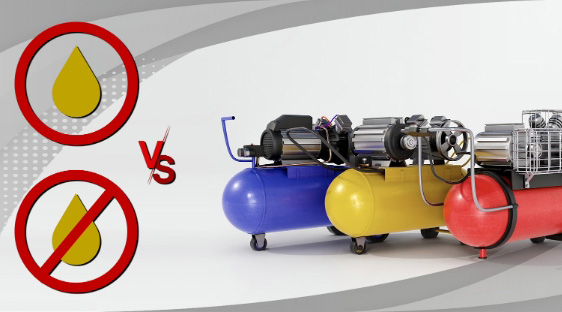
Here's a table outlining the main differences between oil-lubricated (oil) air compressors and oil-free air compressors:
|
Feature |
Oil Air Compressor |
|
|
Lubrication Method |
Uses oil for lubrication, sealing, and cooling |
Uses self-lubricating materials or alternative methods (e.g., water) |
|
Air Purity |
Risk of oil contamination in compressed air |
Produces clean, oil-free air suitable for sensitive applications |
|
Applications |
Heavy-duty industries (e.g., manufacturing, automotive) |
Industries requiring pure air (e.g., food processing, healthcare) |
|
Maintenance |
Requires regular oil changes and filter replacements |
Lower maintenance; no oil changes needed, but other upkeep may apply |
|
Durability |
Generally more durable and suitable for continuous operation |
May have a shorter lifespan in high-demand conditions |
|
Noise Level |
Often quieter due to the lubricating effect of oil |
Can be noisier, as there is less lubrication to dampen sound |
|
Cooling Efficiency |
High, as oil helps dissipate heat effectively |
Relies on alternative cooling methods, which may be less efficient |
|
Initial Cost |
Usually lower than oil-free models |
Higher initial cost due to specialized design |
|
Typical Use Cases |
Construction, automotive shops, industrial production |
Electronics manufacturing, food and beverage, pharmaceuticals |
This comparison provides a clear understanding of the functional and operational differences between the two types of compressors.
Oil vs. Oil Free Air Compressor - Advantages and Disadvantages
Here's a table detailing the advantages and disadvantages of oil-lubricated (oil) air compressors and oil-free air compressors:
|
Type |
Advantages |
Disadvantages |
|
Oil Air Compressor |
- High durability and performance, suitable for heavy-duty, continuous operation |
- Risk of oil contamination in the compressed air |
|
- More efficient cooling due to oil circulation |
- Requires regular maintenance (oil changes, filter replacements) |
|
|
- Generally quieter operation |
- Not suitable for applications needing pure, oil-free air |
|
|
- Typically lower initial cost compared to oil-free models |
- Can be bulkier due to additional oil management systems |
|
|
- Produces clean, oil-free air, ideal for sensitive applications (e.g., food, medical) |
- Higher initial cost due to advanced engineering and design |
|
|
- Lower maintenance; no oil changes required |
- May have shorter lifespan under heavy use conditions |
|
|
- Environmentally friendly, no oil disposal required |
- Can be noisier, as there is less lubrication to reduce sound |
|
|
- Lightweight and compact designs are often available |
- Cooling efficiency may be lower, relying on alternative methods instead of oil |
This table provides a clear overview of the pros and cons associated with each type, helping in deciding which compressor type is suitable for specific needs.
Oil vs. Oil Free Air Compressor - How to Choose?
When choosing between an oil-lubricated (oil) air compressor and an oil-free air compressor, it's essential to consider several factors based on your specific needs and application. Here are the key points to guide your decision:
1. Air Quality Requirements
Choose Oil-Free: If your application requires clean, oil-free air with no risk of contamination, such as in food processing, pharmaceuticals, electronics manufacturing, or medical use, then an oil-free air compressor is the best choice. Oil-free models ensure air purity and comply with strict industry standards for applications where even minimal oil contamination can cause significant issues.
Choose Oil-Lubricated: If air purity is not a critical concern, and slight traces of oil in the air won't affect the process, then an oil compressor might be sufficient.
2. Application and Use Case
Choose Oil-Lubricated: For heavy-duty, industrial applications that require continuous operation over long periods, such as in manufacturing, automotive repair, and construction, an oil air compressor is more durable and efficient. Oil-lubricated compressors are designed to handle intense, prolonged workloads.
Choose Oil-Free: If you need a compressor for lighter, intermittent use or portable applications, oil-free compressors are often lighter, compact, and easier to transport.
3. Maintenance Considerations
Choose Oil-Free: Oil-free air compressors require less maintenance because there is no need for oil changes. This can save time and reduce costs, making them more convenient for those who prefer minimal upkeep.
Choose Oil-Lubricated: While oil compressors need regular oil changes and filter replacements, they are generally more robust and can withstand more intensive use, which could justify the additional maintenance effort for high-demand applications.
4. Operational Costs
Choose Oil-Free: The initial cost of oil-free air compressors is often higher, but they can save money over time through reduced maintenance and the elimination of oil-related expenses (e.g., buying oil, disposal).
Choose Oil-Lubricated: Oil-lubricated compressors tend to have a lower upfront cost, but the ongoing maintenance (oil, filters) can add up, especially for users running the compressors frequently.
5. Noise Levels
Choose Oil-Lubricated: Oil-lubricated compressors are generally quieter because the oil acts as a lubricant and dampens noise.
Choose Oil-Free: Oil-free models can be noisier, but modern designs have improved in this area, with some offering quiet operation suitable for indoor or residential use.
6. Environmental Impact
Choose Oil-Free: Oil-free compressors are more environmentally friendly because there is no oil to dispose of, and they pose less risk of environmental contamination. This can also contribute to safer workplace conditions.
Choose Oil-Lubricated: Oil compressors require proper oil disposal, which can have environmental impacts if not managed correctly.
The choice between an oil and oil-free air compressor largely depends on your specific needs:
1. For clean, oil-free air, minimal maintenance, and environmental friendliness, go for an oil-free air compressor.
2. For heavy-duty, continuous use, lower initial cost, and quieter operation, choose an oil-lubricated air compressor.
Tip: Consider your budget, application requirements, and long-term operating costs to make the most suitable choice.
Best Oil Free Air Compressor Introduction
The Kito Oil-Free Air Compressor stands out as a top choice for industries and applications that demand clean, pure, and contaminant-free air. Designed with advanced engineering, the Kito oil-free compressor ensures that the air you use is free from any traces of oil, making it ideal for sensitive environments such as food and beverage processing, pharmaceuticals, electronics manufacturing, healthcare, and laboratory settings.
With a focus on efficiency, reliability, and low maintenance, Kito has developed a compressor that not only delivers high-quality performance but also reduces operational costs over time. Its state-of-the-art design uses self-lubricating materials and innovative cooling mechanisms to achieve superior performance without the need for oil, ensuring consistent air quality that meets stringent industry standards.
Whether you are looking for a solution to maintain strict hygiene protocols, improve your production quality, or reduce maintenance downtime, the Kito Oil-Free Air Compressor provides a robust, efficient, and eco-friendly solution. Choose Kito for your air compression needs and experience the difference in clean, reliable, and efficient air supply.
Best Oil Air Compressor Introduction
When it comes to reliable, heavy-duty air compression, oil air compressors are often the go-to choice for industries that demand consistent performance and durability. Designed to handle continuous, high-demand operations, oil compressors are well-suited for applications in manufacturing, automotive repair, construction, and industrial settings. By using oil to lubricate, seal, and cool internal components, these compressors offer smooth operation, extended lifespan, and efficient performance even under tough conditions.
Oil air compressors are known for their robust build and efficient cooling, allowing them to run for extended periods without overheating. This makes them ideal for intensive tasks where downtime is not an option. Although they require regular maintenance, such as oil changes and filter replacements, their long-term durability and lower initial cost make them an excellent investment for businesses that need dependable, continuous compressed air.
Whether you need a compressor for a workshop, factory, or construction site, oil air compressors deliver powerful, reliable, and long-lasting performance. For those who prioritize efficiency and robustness over air purity, choosing an oil air compressor ensures that your equipment keeps running smoothly, day in and day out.
Conclusion
Choosing between an oil air compressor and an oil-free air compressor ultimately depends on your specific needs, application requirements, and long-term goals.
Oil air compressors are designed for heavy-duty, continuous operations, making them ideal for industries such as manufacturing, automotive, and construction. They offer robust performance, efficient cooling, and a lower initial cost, which makes them a reliable choice for tasks that demand consistent power. While they require regular maintenance, their durability and ability to operate under tough conditions make them an excellent investment for businesses needing dependable, long-term solutions.
On the other hand, oil-free air compressors are perfect for applications where air purity is critical, such as in food processing, pharmaceuticals, electronics manufacturing, and healthcare. They produce clean, contaminant-free air, which complies with strict industry standards, making them suitable for sensitive environments. Although oil-free compressors may have a higher upfront cost, they offer reduced maintenance, environmental benefits, and portability, which can lead to cost savings over time.
Whether you choose an oil or oil-free model, both types of compressors have their own set of advantages and limitations. For those who prioritize clean, oil-free air and minimal maintenance, oil-free compressors provide an effective and eco-friendly solution. For businesses needing reliability, power, and durability for continuous operations, oil compressors offer a tried-and-true method to meet high-demand needs.
Carefully consider your application, maintenance requirements, and budget when making your decision, and you’ll be sure to select the air compressor that best fits your operational needs.