Español
 العربية
 Pусский
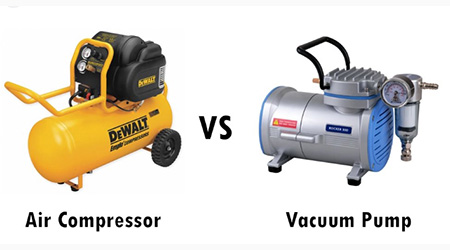
what is an air compressor?
An air compressor is a device that converts power (using an electric motor, diesel or gasoline engine, etc.) into potential energy stored in compressed air. Essentially, it works by taking in air from the environment, compressing it to a higher pressure, and storing it in a tank. The compressed air can then be used to power a variety of tools and equipment, such as pneumatic drills, spray guns, and tire inflators.
what is a vacuum pump?
A vacuum pump is a device that removes gas molecules from a sealed volume to create a partial or complete vacuum. Essentially, it reduces the pressure inside a chamber or system by extracting air or other gases. Vacuum pumps are widely used in various applications, including industrial, scientific, and even household settings.
Air Compressor Vs. Vacuum Pump
|
Vacuum Pump |
||
|
Key components |
Key components of an air compressor:
|
Key components of a vacuum pump:
|
|
Types |
Common types of air compressors:
|
Common types of vacuum pumps:
|
|
Capacity |
Capacity of Air CompressorsThe capacity of an air compressor is generally measured in: CFM (Cubic Feet per Minute): The volume of air delivered at a given pressure. Higher CFM ratings indicate the compressor can deliver more air, suitable for operating larger or multiple tools simultaneously. LPM (Liters per Minute): Metric equivalent of CFM, often used in other regions. Pressure Rating (PSI or Bar): The pressure at which the air is delivered. Common ratings are 90 PSI (6.2 Bar), but industrial compressors can go much higher. Factors affecting compressor capacity: Tank Size: Larger tanks can store more air, enabling tools to run longer without needing to restart the compressor. Horsepower (HP): Higher horsepower means the compressor can produce more air, affecting CFM output. Compressor Type: For example, rotary screw compressors have higher continuous output compared to piston compressors, making them suitable for industrial use. Common Air Compressor Capacities: Portable Compressors: 0.5 to 5 CFM, up to 150 PSI. Mid-sized Compressors: 6 to 20 CFM, 90 to 175 PSI. Industrial Compressors: 20+ CFM, with pressures ranging from 100 PSI to over 300 PSI. |
Capacity of Vacuum PumpsThe capacity of a vacuum pump is usually measured in: Flow Rate (CFM, LPM, or m³/h): The volume of gas it can evacuate from a system or chamber per unit of time. Higher flow rates mean faster evacuation. Ultimate Pressure or Vacuum Level (Torr, mbar, Pa): Indicates the lowest pressure (deepest vacuum) the pump can achieve. A lower pressure number indicates a stronger vacuum. Pumping Speed (m³/h or L/min): Sometimes used to describe how quickly the pump can move gases. Factors affecting vacuum pump capacity: Pump Design: Rotary vane pumps are generally faster at reaching lower vacuums, while diaphragm pumps are suited for lower flow but can handle corrosive gases. Size of Pump: Larger pumps can handle higher flow rates and bigger chambers. Motor Power: Higher power can often mean faster processing, but also higher energy consumption. Common Vacuum Pump Capacities: Small Laboratory Pumps: 0.5 to 10 CFM, achieving vacuum levels of 1 to 10 Torr (133 to 1333 Pa). Industrial Vacuum Pumps: 10 to 200+ CFM, capable of reaching pressures lower than 1 Torr (0.1 Pa) in some cases. High Vacuum Pumps (e.g., Turbomolecular): 0.1 to 50+ CFM, reaching ultra-low pressures like 10⁻⁶ Torr (0.00013 Pa) or lower. |
|
Vacuum Strength |
Vacuum Strength of Air CompressorsAir compressors are generally not designed to create a vacuum. Instead, they compress air to increase its pressure. The term "vacuum strength" doesn't apply directly to air compressors because their purpose is to push air rather than pull it out of a space. However, some air compressors can be adapted to work as basic vacuum pumps by reversing their function, but they won't achieve strong vacuum levels like dedicated vacuum pumps. When used this way, they can create a low vacuum, but their effectiveness and vacuum strength are limited. Air Compressors focus on pressure, measured in PSI or Bar, and not suitable for strong vacuum creation. |
Vacuum Strength of Vacuum PumpsVacuum strength for vacuum pumps is typically measured as the "ultimate pressure" or "vacuum level," indicating how low a pressure (or how strong a vacuum) the pump can achieve. The lower the pressure, the stronger the vacuum. Vacuum Pumps focus on creating low pressures (strong vacuums), with strengths measured in Torr, mbar, or Pa. Different types can achieve varying levels, from low vacuums for simple tasks to ultra-high vacuums for precise scientific applications. |
|
Flow rate |
Flow Rate of Air CompressorsThe flow rate of an air compressor is typically measured in: 1. CFM (Cubic Feet per Minute): The standard unit in the U.S. and North America. It measures the volume of air the compressor can deliver. 2. LPM (Liters per Minute): Often used in other regions. m³/h (Cubic Meters per Hour): Used for larger industrial compressors. Factors Affecting Air Compressor Flow Rate: 1. Compressor Size and Power: Larger and more powerful compressors generally have higher flow rates. 2. Type of Compressor: Rotary screw compressors usually have higher continuous flow rates compared to reciprocating (piston) compressors. 3. Operating Pressure: Higher pressures may reduce flow rates because it requires more work to compress the air. Common Flow Rates: 1. Portable Air Compressors: Typically around 0.5 to 5 CFM (15 to 140 LPM). 2. Mid-Sized Shop Compressors: Around 6 to 20 CFM (170 to 560 LPM). 3. Industrial Compressors: Can deliver anywhere from 20 CFM (570 LPM) to 200+ CFM (5700+ LPM), depending on their size and application. |
Flow Rate of Vacuum PumpsThe flow rate of vacuum pumps is also measured in: 1. CFM (Cubic Feet per Minute): Commonly used to indicate how much air the pump can remove from a chamber. 2. LPM (Liters per Minute): Metric alternative, often seen in scientific and laboratory settings. 3. m³/h (Cubic Meters per Hour): Used for larger vacuum systems. Factors Affecting Vacuum Pump Flow Rate: 1. Pump Type: Rotary vane pumps, diaphragm pumps, and turbomolecular pumps all have different flow capacities. 2. Ultimate Pressure (Vacuum Level): As the vacuum level increases (pressure decreases), the flow rate can drop because it becomes harder to remove remaining gas molecules. 3. Size and Motor Power: Larger pumps with more powerful motors can typically evacuate more air. Common Flow Rates: 1. Small Laboratory Vacuum Pumps: Often around 0.5 to 10 CFM (15 to 280 LPM). 2. Mid-Sized Industrial Vacuum Pumps: Range from 10 to 50 CFM (280 to 1400 LPM). 3. Large-Scale Vacuum Systems: Can have flow rates exceeding 200 CFM (5700+ LPM), especially when designed for heavy-duty or continuous operations. |
|
Power usage |
Power Usage of Air CompressorsAir compressors consume power to compress and deliver air at high pressure. The power usage depends on several factors, including the size, type, and intended use of the compressor. Typical Power Ratings: Small Portable Compressors: Usually range from 0.5 HP to 2 HP (around 0.37 kW to 1.5 kW). Suitable for small tools like nail guns or tire inflators. Mid-Sized Compressors: Range from 3 HP to 10 HP (about 2.2 kW to 7.5 kW). Often used in workshops for running multiple tools or larger equipment. Industrial Compressors: Can be 10 HP to 500+ HP (around 7.5 kW to 375+ kW). Designed for continuous operation in factories or large-scale manufacturing plants. |
Power Usage of Vacuum PumpsVacuum pumps also consume power to evacuate air or gas from a system, and their power usage varies widely depending on the type of pump and application. Typical Power Ratings: Small Laboratory Vacuum Pumps: Often range from 0.1 HP to 1 HP (about 0.07 kW to 0.75 kW). Suitable for low-flow, low-pressure applications. Mid-Sized Industrial Vacuum Pumps: Range from 1 HP to 15 HP (around 0.75 kW to 11 kW). Used in industries like food packaging, HVAC systems, and automotive. Large-Scale Vacuum Systems: Can be 15 HP to 200+ HP (about 11 kW to 150+ kW). Required for high-flow or high-vacuum applications, such as chemical processing, electronics manufacturing, or pharmaceutical production. |
|
Applications |
Applications of Air Compressors1. Automotive Industry: Tire Inflation: Used in service stations and automotive shops for inflating tires. Air Tools: Powering tools like impact wrenches, drills, sanders, and spray paint guns. Car Painting and Maintenance: Providing consistent air pressure for painting, cleaning, and other maintenance tasks. 2. Construction: Pneumatic Tools: Powering nail guns, jackhammers, concrete vibrators, and other construction tools. Site Cleaning: Using compressed air to blow away debris and clean construction sites. 3. Manufacturing: Assembly Line Automation: Running pneumatic systems and machinery for automation in factories. Packaging: Automating packaging lines, including filling, sealing, and labeling. Air Blowing: Removing dust and debris from products during manufacturing processes. 4. HVAC (Heating, Ventilation, and Air Conditioning): Refrigeration Systems: Compressors play a key role in cooling and refrigerant circulation. Air Handling: Maintaining and controlling air pressure in HVAC systems. 5. Agriculture: Crop Spraying: Using compressed air to spray pesticides, fertilizers, and other treatments. Milking Machines: Powering automated milking systems and other dairy equipment. Irrigation Systems: Assisting in pumping water through various irrigation setups. 6. Home and DIY Projects: Painting and Decorating: Running airbrushes and paint sprayers for small projects. Household Repairs: Operating small tools like staplers, drills, and nailers. |
Applications of Vacuum Pumps1. Automotive and Aerospace: Brake Boosters: Creating the vacuum needed for power brake systems. Air Conditioning Systems: Evacuating air and moisture from A/C systems before recharging them with refrigerant. Vacuum-Assisted Equipment: Essential for various aerodynamic testing and component manufacturing in aerospace. 2. Medical and Healthcare: Medical Suction Devices: Removing bodily fluids during surgical procedures. Respiratory Devices: Assisting with ventilators and anesthesia equipment. Sterilization: Creating vacuums in sterilization chambers for medical instruments. 3. Laboratories and Research: Scientific Experiments: Maintaining controlled environments, such as in vacuum chambers and glove boxes. Analytical Instruments: Used in devices like mass spectrometers and electron microscopes. Vacuum Distillation: Separating chemicals at lower temperatures by reducing pressure. 4. Food and Beverage Industry: Vacuum Packaging: Extending shelf life by removing air from packaging before sealing. Freeze Drying: Removing moisture from food without altering its structure or flavor. Bottling: Assisting in filling bottles by creating a vacuum to draw in the liquid. 5. Industrial Processes: Chemical Processing: Creating vacuum conditions for distillation, drying, and degassing. Plastic Molding and Forming: Assisting in the molding of plastic products by creating a vacuum. Semiconductor Manufacturing: Essential for producing microchips and other electronic components in a clean and controlled environment. 6. HVAC (Heating, Ventilation, and Air Conditioning): System Evacuation: Removing air, moisture, and contaminants from HVAC systems before they are charged with refrigerant. Leak Testing: Checking for leaks by creating a vacuum and observing pressure changes. |
|
Operation |
Operation of Air CompressorsAir compressors function by drawing in atmospheric air, compressing it to increase its pressure, and then storing or delivering the pressurized air for various applications. The operation can be broken down into the following general steps: 1. Air Intake: The compressor pulls in ambient air through an intake valve. The air passes through a filter to remove any dust or debris. 2. Compression Process: The air is compressed, which reduces its volume and increases its pressure. This process varies depending on the type of compressor: Reciprocating (Piston) Compressors: Use a piston inside a cylinder. The piston moves down to draw in air and then moves up to compress the air. Valves open and close to allow air intake and discharge. Rotary Screw Compressors: Use two interlocking helical screws (rotors) that trap air between them. As the rotors turn, they compress the air and force it through the system. Centrifugal Compressors: Use a rotating impeller to accelerate and compress the air. The high-speed rotation imparts kinetic energy to the air, which is then converted into pressure. 3. Air Cooling: Compressed air can become hot due to the compression process. Many compressors include aftercoolers to cool the air before it is stored or used, which helps improve efficiency and protect downstream equipment. 4. Air Storage or Delivery: Compressed air can be stored in a tank for later use or delivered directly through a hose or pipeline to power tools, equipment, or machinery. 5. Automatic Pressure Control: Most compressors are equipped with pressure sensors that control when the compressor turns on and off, maintaining a steady pressure within a specified range. This ensures the system operates efficiently and prevents over-compression. |
Operation of Vacuum PumpsVacuum pumps operate by removing air or gas molecules from a sealed chamber or system, creating a vacuum (a space with lower pressure than the surrounding environment). The operation involves the following general steps: 1. Air/Gas Intake: The pump is connected to the chamber or system from which air or gas needs to be removed. When the pump starts, it opens intake valves that allow air or gas to flow into the pump. 2. Gas Removal: The pump removes air or gas molecules, reducing the pressure inside the chamber. The method of gas removal varies depending on the type of vacuum pump: Rotary Vane Pumps: Use a rotating rotor with vanes that slide in and out, trapping and compressing air as the rotor spins. The trapped air is then expelled through the exhaust port. Diaphragm Pumps: Use a flexible diaphragm that moves up and down to create suction and draw in air. The diaphragm’s motion expels the trapped air, creating a vacuum. Turbomolecular Pumps: Use rapidly rotating blades to collide with and expel gas molecules. These pumps are effective for creating high to ultra-high vacuums but require low pressures to operate efficiently. Scroll Pumps: Use two spiral scrolls, one stationary and one moving, to trap and compress air. These pumps are quieter and often used in laboratory settings. 3. Gas Exhaust: Once the air or gas is captured, it is expelled from the system through the exhaust port. Some pumps, especially those used for corrosive or hazardous gases, have filtration or containment systems to handle exhaust safely. 4. Pressure Monitoring and Control: Vacuum pumps often include gauges and sensors to monitor the pressure level. The pump will continue to run until the desired vacuum level is reached. Advanced systems may also have automatic shut-off or variable speed controls to optimize performance and save energy. |
|
Efficiency |
Efficiency of Air CompressorsThe efficiency of an air compressor is typically evaluated based on how effectively it can compress air with minimal energy consumption. Common metrics include: 1. Specific Power (kW/100 CFM): This measures how much power (in kilowatts) is needed to produce 100 cubic feet per minute (CFM) of compressed air. Lower values indicate higher efficiency. Efficient compressors might have a specific power of 18-22 kW/100 CFM, while less efficient models may require more energy. 2. Energy Efficiency Ratio (EER): The ratio of cooling capacity (in BTUs per hour) to power input (in watts). Though more common in HVAC systems, it can also apply to compressors that provide cooling. Higher EER values indicate better efficiency. 3. Compressor Efficiency (%): Expressed as a percentage, showing the ratio of useful output (compressed air energy) to the total energy input. This can vary widely depending on the type, size, and design of the compressor. |
Efficiency of Vacuum PumpsThe efficiency of a vacuum pump is often measured in terms of how effectively it can create a vacuum with minimal energy use. Metrics include: 1. Pumping Speed Efficiency (L/min per watt or CFM per kW): Measures how much air or gas the pump can remove per unit of energy consumed. Higher values indicate more efficient pumps. Efficient vacuum pumps will have a high pumping speed with relatively low power consumption. 2. Ultimate Pressure vs. Energy Consumption: The ability to reach a deeper vacuum (lower pressure) without a significant increase in energy use can be a measure of efficiency. Some pumps, like turbomolecular pumps, are designed for high vacuum levels but may have higher energy demands, affecting efficiency. 3. Overall Energy Efficiency (%): Represents how well the pump converts electrical energy into useful work (creating a vacuum). Higher percentages reflect better performance. |
|
Cost |
Cost of Air Compressors1. Small Portable Compressors:
Price Range: Around $100 to $500 Usage: Suitable for basic DIY tasks, inflating tires, and powering small tools. Example: 1 to 2 HP piston compressors or small oil-free models. 2. Mid-Range Compressors (Workshop/Industrial):
Price Range: Around $500 to $5,000 Usage: Ideal for small workshops, automotive repair shops, and light industrial use. Example: 3 to 10 HP rotary screw or reciprocating compressors. 3. Large Industrial Compressors:
Price Range: Around $5,000 to $50,000+ Usage: For continuous heavy-duty applications in factories, manufacturing plants, and large-scale facilities. Example: 15 HP to 500+ HP rotary screw or centrifugal compressors. |
Cost of Vacuum Pumps1. Small Laboratory or Home Vacuum Pumps:
Price Range: Around $50 to $500 Usage: Suitable for light-duty tasks, such as basic lab experiments, small vacuum sealing, or air conditioning maintenance. Example: Small diaphragm or rotary vane pumps. 2. Mid-Range Industrial Vacuum Pumps:
Price Range: Around $500 to $5,000 Usage: Common in medium-scale industries, for applications such as food packaging, chemical processing, and HVAC. Example: Larger rotary vane pumps, dry scroll pumps, and small turbomolecular pumps. 3. High-Performance Industrial Vacuum Pumps:
Price Range: Around $5,000 to $50,000+ Usage: Required for specialized, high-performance applications in sectors like electronics manufacturing, pharmaceutical production, and scientific research. Example: High-capacity rotary vane pumps, large dry vacuum pumps, and advanced turbomolecular pumps. |
|
Pressure |
Pressure of Air Compressors:1. Purpose: Increase the pressure of atmospheric air. 2. Typical Pressure Range: Generally operates at pressures from 30 psi (pounds per square inch) up to 250 psi or more, depending on the application and type of compressor. 3. Output: Delivers high-pressure air for tools, machinery, and various applications. |
Pressure of Vacuum Pumps:1. Purpose: Create a vacuum by removing air or gas, resulting in lower pressure than atmospheric pressure. 2. Typical Pressure Range: Achieve vacuum levels from 1 atm (atmospheric pressure) down to ultra-high vacuums of 10^-9 torr or lower. 3. Output: Provides a low-pressure environment for applications like packaging, laboratory experiments, and industrial processes. |
|
Working |
Working of Air Compressors:1. Mechanism: Draws in ambient air and compresses it using mechanical components (like pistons, screws, or impellers). 2. Process: The air is compressed to increase its pressure and then stored in a tank or delivered directly for use. 3. Function: Converts electrical energy into mechanical energy to produce high-pressure air for various applications. |
Working of Vacuum Pumps:1. Mechanism: Removes air or gas from a sealed chamber using various techniques (like rotating vanes, diaphragms, or blades). 2. Process: Air or gas is evacuated, creating a vacuum (low-pressure environment) within the chamber. 3. Function: Converts electrical energy into a suction force to achieve and maintain low pressure in a system. |
|
Maintenance |
Maintenance of Air Compressors:1. Maintenance Needs: Regular maintenance includes checking and replacing air filters, changing oil (for oil-lubricated models), inspecting belts and hoses, and monitoring pressure levels. 2. Common Issues: Potential problems include air leaks, overheating, and wear on mechanical components. Regular servicing is essential for efficiency and longevity. |
Maintenance of Vacuum Pumps:1. Maintenance Needs: Maintenance involves checking and replacing oil (for oil-sealed pumps), inspecting seals and gaskets, monitoring for leaks, and ensuring proper operation of valves. 2. Common Issues: Issues may include loss of vacuum due to leaks, oil contamination, or wear on internal parts. Regular checks are crucial for maintaining vacuum performance. |
|
Advantages |
Advantages of Air Compressors:1. Versatility: Can power a wide range of tools and equipment (e.g., pneumatic tools, spray guns). 2. Availability: Widely available in various sizes and types to suit different applications. 3. High Pressure: Capable of delivering high-pressure air for demanding tasks. |
Advantages of Vacuum Pumps:1. Low Energy Consumption: Often more energy-efficient than air compressors, particularly in applications requiring low pressures. 2. Quiet Operation: Generally operate more quietly, making them suitable for sensitive environments. 3. Specialized Applications: Essential for creating vacuums in industries such as packaging, pharmaceuticals, and research. |
|
Disadvantages |
Disadvantages of Air Compressors:1. Energy Consumption: Can consume significant energy, leading to higher operational costs. 2. Noise Levels: Often noisy during operation, which may require soundproofing measures. 3. Maintenance Requirements: Required regular maintenance to ensure efficient operation and prevent breakdowns. |
Disadvantages of Vacuum Pumps:1. Limited Versatility: Primarily designed for specific applications, not suitable for powering tools or machinery. 2. Complexity: Some types (e.g., turbomolecular pumps) can be complex and costly to operate and maintain. 3. Potential for Emissions: Oil-sealed models may produce waste oil, requiring proper disposal and management. |
Both air compressors and vacuum pumps play vital roles in various industrial applications, each serving unique purposes. Air compressors are designed to increase atmospheric air pressure, making them ideal for powering tools and machinery. They are versatile and widely available, but they tend to consume more energy and can produce noise during operation. Regular maintenance is essential to keep them functioning efficiently.
On the other hand, vacuum pumps are specialized devices that create a low-pressure environment by removing air or gas. They are energy-efficient, operate quietly, and are crucial in industries such as packaging and pharmaceuticals. However, they are less versatile than air compressors and may require careful handling of waste emissions.
Ultimately, the choice between an air compressor and a vacuum pump depends on your specific needs and applications. If you are looking for high-pressure solutions for your industrial operations, consider investing in an industrial air compressor.
For reliable and efficient industrial air compressors that meet your operational requirements, visit Kito today! Our extensive range of air compressors is designed to provide optimal performance while ensuring energy efficiency.