Español
 العربية
 Pусский
In most industrial applications, common air compressors suffice to meet the majority of demands. Nevertheless, when there is a need for pressure levels beyond what a standard compressor can provide, the use of a booster compressor becomes necessary. Booster compressors represent a distinct type of compressor designed to elevate the pressure of the primary feed air compressor.
In simpler terms, a booster compressor is a specialized apparatus employed to augment or amplify the pressure of compressed air derived from the current air compressor. Through the supplementary use of an air booster, the compressed air undergoes additional compression stages. Consequently, the booster compressor has the capability to elevate the initial air pressures, typically ranging from 80-150 psig, to levels as high as 2000 psig.
Piston Technology
A booster compressor commonly employs specialized piston technology to effectively handle higher pressures. Utilizing a single-stage or multistage pump, it works to compress air or compressed gas. The design of the piston block and cylinder diameters is tailored for the demands of these elevated pressures, ensuring efficient energy utilization and effective treatment of upstream air or gas. Boosters are offered with both oil-injected and oil-free compression technologies to maximize air quality based on specific requirements.
The Efficient High Pressure Solution
Achieving compressed air or gas at higher pressures can be approached in various ways, such as elevating the overall plant pressure or employing an amplifier or stand-alone high-pressure compressor. However, the preferred solution often involves the use of a compressor/booster combination. This choice is driven by its enhanced energy efficiency, thereby reducing costs. Leveraging already compressed air reduces the differential between inlet and outlet pressure compared to starting from ambient air, resulting in improved performance and energy efficiency.
Furthermore, a compressor and booster combination offers greater flexibility. Various pressure booster models are available, allowing for the selection of an ideal fit for a specific application. Moreover, the standard compressor, part of this combination, can serve additional on-site pneumatic applications, adding to its versatility.
The Oil Free Booster Compressor: Use And Benefits
Applications involving compressed air and industrial gases can be categorized based on their pressure requirements, namely low, medium, and high. Standard pneumatic tools and equipment typically operate within the pressure range of up to 13 bar, easily supplied by a conventional air compressor. A multitude of operations, spanning from workshop tools to industrial packaging equipment and train braking systems, falls within this low-pressure category.
However, certain specialized applications, such as laser cutting and PET bottle production, demand higher pressures. These requirements range from 25 or 40 bar (considered medium pressure) to as high as 300, with some applications even reaching up to 1000 bar (considered high pressure). This is where the significance of a booster compressor becomes evident. This article aims to elucidate what a booster compressor is, why and when it is necessary, the advantages it offers, and the operational principles governing its functionality.
How Do You Increase Compressed Air Pressure?
In theory, there’re mainly three ways:
To augment the quantity of gas, there are several methods. One approach involves adding more gas molecules, thereby increasing the frequency of collisions between air molecules and subsequently raising the pressure.
Another method involves elevating the temperature of the gas. By increasing the air temperature, the motion between gas molecules intensifies, leading to a rise in pressure.
Additionally, reducing the volume of the gas is an effective means. Gas, being inherently compressible, can be compressed and confined to a smaller container, resulting in higher pressure.
Both the air compressor and the booster compressor serve the purpose of amplifying gas pressure by decreasing its volume.
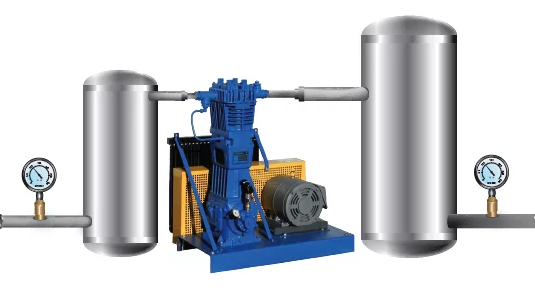
The gas booster compressor is primarily composed of a receiver tank, pipework, and a discharge tank. The process begins with the receiver tank's inlet, where compressed air from the air compressor is received. Subsequently, the gas undergoes multiple compression stages, further intensifying its pressure. Finally, the pressurized gas is directed through the piping into the discharge tank, which houses an outlet supplying the gas to the designated site.
5 Benefits Of An Air And Nitrogen Booster
Opting for a compressed air booster is a wise decision if your production necessitates high-pressure air or nitrogen. This unique compressor is designed to take low-pressure air or nitrogen and elevate its pressure to as high as 1,000 bar. Indeed, a standard combination of an air compressor and booster emerges as the most versatile and cost-effective solution for applications requiring high-pressure air and gas. However, it's essential to note that not all air and nitrogen boosters can deliver these benefits.
Similar to most industrial equipment, the quality of the booster is paramount. Choosing the right booster not only ensures the generation of high-pressure air or nitrogen but also translates into savings and significant added value.
Cost
Cost considerations are paramount whenever you're faced with an investment decision in industrial equipment. When it comes to air boosters, it's crucial to recognize that the initial price of the product is just a small component of the overall cost of ownership. The majority of your compressed air and nitrogen generation budget is typically allocated to energy consumption.
Efficiency
Speaking of energy consumption: Most of the money you spend on your compressed air/nitrogen booster will go toward the electricity it consumes. This costs you money, and it affects your environmental footprint. In short: energy savings are key.
Continuous Duty
To take advantage of the benefits of your compressed air booster, it has to be running. However, the piston compression technology that most boosters rely on typically requires frequent cool-downs.
Reliability
Dependability is crucial for any equipment that is an important part of your operational chain. After all, booster downtime equals production shutdown, which equals lost revenue. Dependable boosters feature sturdy, high-quality components (its pump, motor, valves, roller bearings and connecting rods are a few examples) and robust engineering.
Quiet Operation
Many boosters produce too much noise and too many vibrations to allow production floor installation. That makes low noise emissions a key requirement for installation flexibility and cost savings.
After years of accumulated production, research and development experience, KITO has achieved the best production process standards. Through strict inspection and monitoring throughout the entire process from trial production to finished products, we ensure that the quality of them meets the standards and customers’ requirements.